Showing posts with label chicks. Show all posts

Monday, July 1, 2013

SMALL PACKAGES

HOW LONG HAS IT BEEN SINCE I'VE SET EGGS IN AN INCUBATOR AND TURNED THEM PATIENTLY FOR THREE WEEKS? Many years. We did it in the early days a few times, but mostly bought day old chicks by mail—a different kind of patience, a different kind of waiting. When you order chicks by mail, you get a range of dates they might arrive. Expect an early call. Our postmistress usually calls before 7 to tell me that a suspicious package has arrived in my name—full of cheeping! I drive the mile and a half to town and she cheerfully hands me a box. She tells me she likes this kind of package, but last week someone ordered bees! She was afraid of the buzzing and didn't want to get too close even though it was tightly wrapped. I don't tell her that I aspire to someday receive a mail order package of bees.
How can they send chicks through the mail? They have to put enough chicks into the box to keep them warm through body heat to make the trip, Some places will send “warmer chicks” if you order only a few They are cushioned in straw. Before they hatch, chicks absorb all the rest of the yolk through the umbilicus (Yes, chickens have umbilical cords!) and that gives them all the food and water they need for the next 24 hours. After hatching, they need time to dry off and learn to walk. No time for eating until those important tasks are finished. They make the trip overnight and I get to open the box of peeping chicks. I used to order the bargain mix, which really just means the leftovers from the hatchery. Opening the box for me was even more exciting, since I got to see what kinds of chicks I had. They're not all yellow. Look at a hatchery catalog sometime to see the colorful assortment of chicks. We always had fun transferring them from the box to the brooder, counting them carefully. The hatchery often throws in one or two extra, in case some don't make the trip. When I put them in the brooder, the first task is to show them each, one by one, where the food and water are. I dip their beaks in the water, and set them down, so they know where to find it again when they are thirsty.
Well, that was how we used to do it, but this spring I got a hankering to hatch out some Serama chicks. Seramas are sometimes called "the teacup chicken" because they are so tiny. A full-grown rooster is about the size of a 6-week-old kitten rolled up in a ball. Before I could talk myself out of it, I ordered a dozen Serama eggs. I set up an incubator and marked the eggs with an X on one side so I could tell that I was giving each egg a full turn. I realized later I should have put an O on the other side. 
My memory of hatching is pretty foggy. You need to turn them 3 times a day (or 5 or any odd number). If you let them lie on the same side for 21 days (or even for most of that time) the chicks will develop unevenly--one side of their body bigger than the other. I did faithfully turn them, but I forgot the part about leaving them still for the last 3 days. In fact, I didn't remember that until yesterday, when I went to turn them and heard peeping! 
At first I thought it was my imagination, or that a bird had flown into the vent fan again and made a nest. I had read that you could hear chicks peeping from inside the eggs, but I had never heard it myself. Oh my! Time to get a brooder ready. Three eggs had tiny chips. When I exclaimed the peeping grew louder. They were responding to my voice. I kept checking, but the cracks didn't seem to get any bigger. I checked the humidity. If it's too high, the chicks can drown in their shells. The humidity was in the right range. I had to go to town, and when I returned I found 2 sets of eggshell halves and 2 tiny, wet chicks peeping and trying to stand. The chick uses its egg tooth to cut the shell in a perfect circle, all the way around, so the top of the egg comes off like a little hat. The chicks went into the brooder (a box with a light bulb), but I didn't hear any more peeping. The next morning, one more wet chick was in the incubator, and he joined his nest mates. Will more eggs hatch? The adventure begins.
Wait in Beauty; Hatch in Peace; Blessed Be.

Thursday, May 31, 2012

PAUSE BRINGS TEMPORARY CONFUSION

I FEEL A BIT DISORIENTED.
IN BIRDLAND WE ARE TAKING A PAUSE. One hectic cycle has suddenly ended and I feel a bit disoriented, like the Ferris Wheel has just stopped, and I have stepped off. The world still seems to be turning, but I am now looking around at a new view, wondering where to go next.


CURLING CREPE
OF CALYX

In my confused state I cast around for a topic to write about. Should I tell you about the chicks? Growing healthy and into their adult plumage, tiny feathers along their shoulders and backs and wingtips. The Auracanas, contrary to expectation, are growing tail feathers. It's warm enough now, that they can be outside all day without the lamp, but I'll leave it on a few days yet, for comfort. I still bring them in at night for protection, but they'll soon graduate to the big coop for the nights. It's more secure than the chick creeper. I find myself obsessively counting them every time I move them or visit. Yep, 4 of the yellow Orps, 4 of the Rhode Island Reds, 4 Auracanas with their funny muttonchops. But you're probably tired of hearing about the chicks by now. 
IRIS IS ON HER WAY OUT


Should I tell you what's blooming? Iris, I'm afraid, is on her way out. I know I should deadhead the stalks, but I find myself staring in stunned appreciation of their post-blooming state. The calyx of each flower has dried to an antique crepe, cupping the space which held a lovely flower just a few days ago. Some wilted flowers still hang on, and I'm fascinated with these faded blooms, curling inward as they dry, the pale, lavender color of the petals fading to a spidery blue. I once worked in a bakery and we had a bouquet of Gladioli. They were lovely in their blooming, but just as lovely as they faded. I left them there in the vase on the counter until a woman came in and told me that they were past their bloom. The baker and I chuckled about it later. I emptied the vase and hung the flowers upside-down behind the counter. They kept their beauty for a long time. In my yard, Peonies won't be far behind the Irises, though they're mostly still bright and bushy. Daisies are still fresh for awhile, yet, and the day lilies are still in bud. Always something is fading while something is just ready to open. But you are surely tired of hearing about the flowers.


Suddenly, with this great pause, I can think about getting my house in order. The breakfast dishes are waiting, and some from last night. The knives are laid on the counter waiting to be carefully washed and honed. 

My boys gave me a nice set of knives for my birthday. They told me they were tired of the dull ones I've always had. I never learned to hone knives, but I want to keep these nice, and it's really easy. The rituals of domestic tasks always seems meditative to me. Hanging laundry on the line—shaking each item to soften it and get rid if wrinkles is like shaking the troubles from my head. Sweeping the floors is like pushing my problems into a manageable pile; and yes, even washing dishes helps me focus and plan my day. I wash and dry each knife carefully, and then hone it like my boys showed me. Taking good care of a gift my sons gave me feels like I'm taking good care of them. But I'm very sure that you're tired of hearing me talk about my domestic chores.


WHAT NEXT?
 No, I don't know what to write about this week, and I hope you'll forgive me while I stand her for a moment, blinking in the sun, trying to decide what ride to try next.

NEW CHICKS IN BIRDLAND

URSA SURVEYS BIRDLAND
BIRDLAND IS SUNNY AND GREEN. The rain barrel is full and the little pond is fresh. A few weeks ago I dropped in a plastic bag with 12 feeder fish. You let the temperature equalize before you open the bag. That way the shock of cold water won't kill them. Later, when I tore open the plastic, the fish swam promptly under the leaves of the water lilies and now hang out in the roots of the cattails. They swim up to sun themselves, but they're shy yet. Soon they will learn to come out when I sprinkle fish food on the surface of the little pond, their mouths opening to nibble the flakes. On the edges the Day Lilies are bushy, and sending up stalks with little buds like the pods of squat green beans. The flat leaves of Ghost Lilies are drooping, yellowing. Soon they will fade back into the ground and we'll forget all about them. I almost did forget them in the hustle of new blossoms in the yard. 


MORNING COFFEE
BIG, SHOWY, EGGPLANT
COLORED BLOOMS
Sunny Daisies bounce in the wind. My grandmother's peonies open their generous blossoms, each almost a bouquet in itself, perfuming the yard. A few of my new Irises are blooming for the first time—big, showy blooms in a dark Eggplant, a soft, buttery yellow and white, another the deep, golden color of the yolks of eggs. The eggs I won't taste again until December. The yard is quiet now, after last week's coyote attack. Well, quiet of chickens, though we still hear the musical trills of frogs, and the chirpings of the parakeets in the aviary, and the singing of all kinds of wild birds. But the house, on the other hand, is another story. Listen carefully! In the back, closed in behind a sliding door, can you hear the soft peeping of new chicks? We'd been searching for a solution to our problem. I didn't want to order a flock of 25 that most hatcheries require, when a dozen would do. We looked online and found a few local possibilities, but the competition is fierce. Local broods seem to go fast and only one person with day old chicks answered my queries. These were the rare Lavender Orpingtons, and I was sorely tempted to order a few, but $9 each was too rich for my blood. There was a picture, and they are just lovely! Not really lavender, but a soft grey with rosy overtones. I don't have to use too much imagination to see Lavender. I thought about getting a breeding trio—a cockerel and 2 pullets—but these were straight run day olds. I only had a chance of getting one of each sex. We kept looking, kept emailing, prowled the farm stores in town for chicks.

MY GRANDMOTHER'S
PEONIES OPEN

Finally, after I had just about decided to order 25 from a hatchery, I came up lucky at the farm store. They were selling not just day old chicks, but day old pullets and I bought an even dozen—4 Buff Orpingtons, the soft, fluffy, good-natured chickens who make gentle, reasonable mothers and lay big tan eggs; 4 Rhode Island Reds, more businesslike, who lay brown eggs; and 4 silly Auracanas—rumpless, bearded ladies who lay eggs in a greenish, bluish tint. They're still under lights in the house, but we've been allowing them playtime out in the chick creeper. They are content scratching in the grass, running back to the warmth of the light when they get chilly. Soon they'll begin feathering out and will graduate to more and more time away from the lights until they can stay in the yard all day and just come in the house at night.
KEEPING WARM


they are content scratching
in the grass
The chicks will feather out, grow gangly and awkward, and finally take the matronly shape of a hen and begin to lay eggs around the winter Solstice, when I turn on the lights for warmth. Perhaps a few of these pullets will turn out to be cockerels after all. It's happened. It's hard to tell the difference in a day old chick. One way or another, we'll need to get a rooster or two to protect the flock as best they can. Maybe in a few weeks I'll email the woman with the Lavender Orps. Maybe she'll have a few left. Maybe she'll sell me a breeding trio or at least a pair, on the cheep.

SCATTER BEAUTY; CIRCULATE PEACE;
BLESSED BE!

Friday, May 25, 2012

EGGS OF POSSIBILITY

WHAT DO YOU DO WHEN YOU WAKE UP TO DISASTER? Do you carefully set aside the last four eggs for hatching? Or do you decide to savor them one by one? Do you replay the night before in your head over and over, thinking how you could have changed one little thing, and that would have made the difference? Do you curse the world or yourself or another? Or do you vow to be more organized, stronger, smarter, kinder, from here on out? Do you mourn what you've lost? Or claim what remains to you?


IRIS PAST THEIR BLOOM.
 Yesterday morning I woke to a long streak of feathers blown across the yard, and a worrisome quietness. I opened the lid of the coop to a sad vista. Not the gruesome scene of a weasel attack, with headless bodies lying limp. No, this was, I think, the work of coyotes. The coop door hanging open, piles of down in the corners of nest boxes, on the floor. The smell of feathers hangs in the air. I walk around the yard, calling for survivors. Maybe some managed to run under the shelter of the cedar grove, where they hide when they see a hawk circling. Maybe someone made it to the machine shed. The yard remains quiet and I find brave Chaucer lying still in the bed of poppies. His lovely red comb and wattles are stark against the green, the heads of poppies keeping quiet watch. He has kept his feathers, but the back of his neck is bloodied, his feet stretched out behind him. I imagine the heavy spurs landed some blows before he was caught. He would have fought bravely to protect his flock.


IRIS BLOOM
 I look out into the cornfield, now softly striped with fuzzy rows of green, new life emerging. Another spray of feathers halfway to the grass waterway shows where the dogs had their picnic. I sigh and return to the house. Sadness sweeps over me, but I can't let it defeat me. I've been here before. I know that living in the country comes with joys, but the country can also extract a price. I can't really be angry with predators who are just expressing their nature. In fact, predators help us keep an equilibrium. Coyotes, possums, skunks, hawks, weasels all eat chickens, yes. But they also eat rats, mice, and even rabbits whose gentle persona belies their capacity for destruction if they are not kept in balance by predation.


In the kitchen I find four eggs from yesterday. Two are white, one tan, one a deep brown. I could set these in an incubator and in three weeks have some chicks. Or I could eat these, and buy some day old chicks already hatched. What to do? Either way, it will be a good, long time before I have fresh eggs in my kitchen to coddle again. Perhaps December. I look out into the yard to consider. I see the summer laid out in front of me, full of opportunity. The sweet rocket is at its peak; Daisies are just beginning to bloom. Peonies are tight round bulbs ready to burst into a full blossom. My new iris varieties are beginning to open. These are two-tone—one has lower petals of deep purple, upper petals a soft lavender—another is purple and brown. One opened with buttery yellow blossoms, another is just beginning to reveal petals of a deep, almost black, crepe.
 
PEONIES ARE TIGHT ROUND
BLOOMS READY TO BURST
IN FULL BLOSSOM.

Further out I see the brown and green corduroy fields of corn, lines going straight back to the fence row. Yes, my summer is all laid out, full of opportunity. These four eggs each contain a rich, yellow yolk. If I crack them open I will see a tiny circle with a small, bright dot in the center. If I crack the eggs open, they will be delicious. If I keep them warm and turn them three times a day for 21 days, I will have 4 chicks. Either way, these four eggs are full of possibility. What would you do?

Await Beauty; Balance Peace; Blessed Be.

Wednesday, May 2, 2012

CALL ME ISHMAEL

And I alone survived to tell thee.
SPRING IN BIRDLAND MEANS CYCLING THROUGH LIFE IN RAPID SUCCESSION. On any given day in the spring we have flowers in bud, in bloom, and already gone to seed. Some, having lived out their cycles are already dying, or sinking back into the earth to wait for next year. Some species, like Dandelions, are doing it all at once—tight buds; sunshiny blooms; starry seed puffs; and the sad, empty stalks, like pencil erasers, already forgetting their previous splendor. We've already said goodbye to the early spring blossoms—Lilac, Redbud, Tulips, Daffodils, the bush in the front yard that I mistakenly call Weigela every time it blooms, but it is really a coral pink Rose of some type, no spines, but the Rose family's flowers of five regular petals. Now that the Weigela bush is really blooming, I remember that it's a different flower altogether, and looks nothing like the lush, spherical bush in the front yard.


Now comes the bluish-pink Sweet Rocket and its albino cousin, Horseradish. Yes! Horseradish is one of my favorite flowers, all decked out in bright white lace, like a wedding party, the leaves below in thin green tendrils now, like festive party streamers. In a few weeks those will grow into massive leaves with a sinuous curvature—just in time to fill out a tall bouquet of Day Lilies and Cat Tails. The Iris surrounding the house are just about to break into bloom, already a few early blossoms are sending out their delicate, powdery scent.


But flowers don't offer the only visitation to our yard. We've been hosting an unwelcome guest, too. A hungry varmint, probably a raccoon, has been breaking into my little chick creeper. Each time I would fortify it more strongly, but to no avail. One night we came home late to find one little Rhode Island Red pullet wandering around the yard. Did she know what was about to happen? I opened the top of the chick creeper and felt in the dark to see if the other chicks were already in bed. They were, and I popped the last little chick in the box, and closed up the both lids, laying heavy rocks and bricks on top. In the morning I woke to a mostly empty coop, just a pile of black and white feathers from the Barred Rocks. The brute had dug underneath and dined in the privacy of the chick creeper. All my fortifications were wasted. A few hours later, however, I heard a little peep-peep-peep-peep-peep. Out from the bushes came running my little Rhode Island Red. I named her Ishmael, and put her in with the big chickens. That was a week ago, and she's still traumatized. She spends her days in the dark coop, only coming out when I visit. Then she will run out and circle my feet like a cat until I pick her up and put her on my shoulder. I tell her she needs to get some sun, scratch in the yard and grow big and strong. I take her to various places where the grass is succulent and the bugs are abundant, but the next time I go to check for eggs, there she will be in the dark.


Meanwhile, I will fortify the chick creeper with stronger chicken wire, and maybe let one of the hens set some eggs in there as a last ditch effort to increase the flock a little against predation this summer. I find that the best kind of incubator is a hen, who will also be the brooder. No need to keep the hatchlings warm with lights—she will warm them with her generous, feathery insulation.


They will grow fat on bugs and grubs.
  She'll also teach them the ropes of scratching and other chicken behavior. She'll protect them from the bullying of the big chickens, and they will grow fat on bugs and grubs and the varied diet of a free range chicken.
Bloom in Beauty; Scratch in Peace;
Blessed Be.

Thursday, March 22, 2012

SPRING IS AROUND THE CORNER


THE CORNER OF THE YEAR IS A SHARP ONE THIS TIME. Spring came to Birdland, stayed for a few minutes, and already summer seems to be settling in. Temperatures in the high 70's accelerate the budding, blooming, bursting out of all the green, growing things. In town this morning I saw a carpet of redish gold mulching the sidewalk and surrounding lawn. When I got close I saw it was the tiny florets of trees fallen from above. Did you ever look at the subtle flowers of Maples or Walnuts? Since they are wind pollinated, they don't need to show off with flashy petals or haunting scents, like, say, a Horse Chestnut or Lilac. The wind comes, or it doesn't, regardless of the wiles of Nature. And if the pollen blows in the right direction, a seed will form. Maple flowers come in minute pink clusters, like tiny bouquets, and Walnut flowers are long, limp, green catkins.


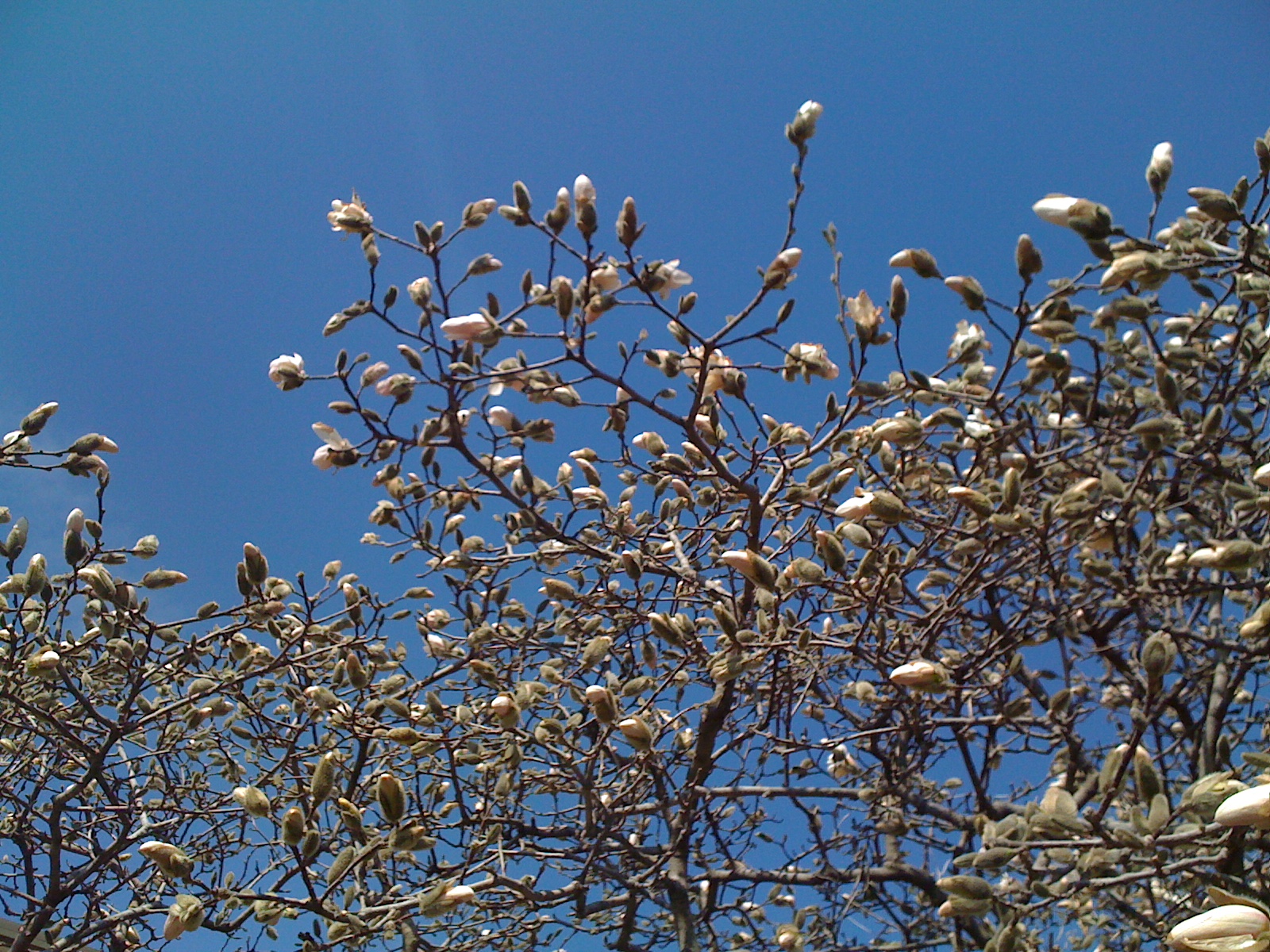
 Up the block was a Magnolia tree, the big pink flowers popping out of their calyxes, which lay all over the sidewalk like the empty hulls of giant pistachios, like the open mouths of birds. The shell-pink petals were still wrapped in large, conical buds, twice as long as their discarded calyxes. Yes, the heat is cooking all these flowers to an early emergence.

THE CHICKS ARE
FEATHERING OUT NICELY.

At home, crowds of Daffodils nod their heads in the breeze. Crocuses are open, too, the rich color of the yolks of my hens' eggs. Irises stand guard around the house, each leaf enfolded to make a fan growing taller every day, to form a spiky, dark green border. Lighter green day lilies emerge in a circle in the back yard like little symmetrical fountains of greenery. These won't bloom for a few months, but their vegetative parts are almost like green corsages pinned to the earth. Leaves of ghost lilies grow inches a day, and will fade even more quickly. Next to the birdbath we find red sprouts pushing out from amongst the dry, grey stalks of peonies. Everywhere we turn is a flower, or the promise of one. I find more Irises sprouting near my path to the door where I had forgotten I planted them. I will need to be extra careful when I mow in a week or two. Yes, the grass is greening up and growing fast.


The chicks are feathering out nicely, and I have been taking them outside to the little chick tractor during the day when it's sunny. It is a movable, bottomless coop so they can have access to the grass and all its varied treats. It's called a “tractor” because if you leave it in the same place for a while, a week or maybe a few days, the chickens will scratch so much that they can actually plow up your garden for you. I move it a little each day, so they can fertilize the yard evenly, but I don't let them plow up the lawn. When they get big, they will have the run of the whole yard. The grown up chickens come over to investigate and the chicks get flustered, running in a feathery flurry to get away from giant, curious beaks from above. Bit by bit they will get used to each other. Ursula noses the chicks' coop, but if you want to know the truth, she is most interested in their food. My dog could easily tear through the chicken wire in my little chick tractor, but I convince her that it's much more fun to chase a tennis ball. “Where's your ball?” I ask, and she tilts her head for a moment, and then turns toward the driveway, where we last had our game. She runs this way and that, searching, and in a few moments she returns with a faded tennis ball in her mouth. The game distracts her from the chicks and disaster is temporarily averted. She retrieves her ball again and again, and with each throw I move the game away from chicken territory. The chicks return to their inspection of their new grassy pen, and each in our own way, we enjoy the afternoon.
 
URSA NOSES THE CHICKENS' COOP
WELCOME BEAUTY; CULTIVATE PEACE; BLESSED BE.

PROMISE OF SPRING


A CLUSTER OF EMPTY VASES
READY TO FILL
SPRING HAS COME TO BIRDLAND IN THE SOFT GREENING OF THE WINTER-BROWN GRASS. Bulbs are pushing up in various fashion, the flat, green tongues of ghost lilies emerge stacked like pages from the damp earth; Daffodils thrust up in a green bouquet, like a gift from a friend; red edged tulips curl to make a cluster of empty vases, ready to fill; spikes of crocuses appear, like birthday candles, with a large, yellow flame. The Daffodils are already trumpeting their message: Hear Ye, Hear Ye! Spring Comes Early This Year.

 The wind blows fiercely, and in the yard, lawn furniture is overturned and twigs, branches, and even limbs snap off of trees and tumble to the ground. It seems like every day we right the chairs and carry broken branches to the mulch pile, but the spring yard is always in disarray. Ursula finds plenty of sticks to coax us into a game. Our dog loves to fetch. The big bushes in the front yard—some kind of dusky pink kin to the rose—has put out flower buds. They are like pink capers, wrapped tight against the wind. But the surest sign of spring in Birdland is peeping next to the wood stove. That's where the brooder is. Okay, you knew I was going to go back to that farm store and get those chicks, didn't you? We have a dozen. Six Buff Orpingtons, and three each of Rhode Island Reds and Barred Rock. They are straight run, which means that half will be pullets and half cockerels, the natural ratio. At the time, a dozen seemed like plenty, but suddenly only 6 hens next year seems like such a small number, especially accounting for predation. Maybe I'd better go back before the sale ends.
HEAR YE, HEAR YE!
SPRING COMES EARLY
THIS YEAR!


For now the chicks are in the brooder, under lights, but I hope soon the wind will die down, so I can set up a temporary pen in the grass. They'll be less bored outside, where they can scratch in the ground and snap up grass and dandelion greens. They'll be healthier, too, and easier to keep clean. Chicks only get “pasty butt” when they are in an artificial brooder. In the yard, grazing on a more varied and natural diet, they are in a better balance. Once they feather out and lose their soft down, they won't even need a light. Won't they be surprised to discover that the world is wider than the plastic crate they live in now?


Like Birthday Candles
with Yellow Flame
 “Spring is the mischief in me,” and the next thing I know, I'm online and looking up “Serama hatching eggs.” Seramas are the smallest breed of chicken. Sometimes called “the teacup chicken.” They are about the size of a large can of soup with a tail. A couple of my hens have been broody, lately. I find especially the little red hen sitting in the next box in the dark warming a clutch of eggs mostly stolen from her sisters. I could order a dozen Serama eggs, set up a nest in a crate in the basement and set her on top of the serama eggs. She would hatch them for me, and then raise the babies. They will follow her around the yard as she shows them how to scratch and peck in the wild jungle of grasses in the yard. When they get cold, she'll sit down so they can run to her and burrow into her warm feathers. They can live in the aviary with the finches and parakeets.

Hatch in Beauty: Bloom in Peace:
Blessed be.

The wind will die down; the sun will coax open more buds; new chicks will scratch and graze. Spring will come and leave us again to make way for summer.