Showing posts with label garden. Show all posts

Monday, September 24, 2012

DROUGHT'S END?

BIRDLAND IS GREENING UP. The drought is not over, we're still several inches down. We lost trees and perennials to the scorching heat. My store of carefully picked walnuts is almost gone, and the tree in my front yard is barren this year. I will have to wait until next fall to sit cracking black walnuts again for scones and muffins and pesto. But in many important ways my emotional drought is over. 

 I think those 100+ degree days addled my brain. I remember my ridiculously petulant refrain, whining about the heat, the lack of green, my lack of energy, death all around. Last week I found myself in my yard paring apples and it suddenly struck me: I feel good! The modest rains brought us a sweet coolness and saved some of the plants. My tomatoes are in full bloom and I finally harvested a few of the little grape tomatoes. Even with irrigation, they didn't seem to pollinate in the high heat. Now they are trying to catch up. My cucumber vines, which in past years have filled my big crockery bowl almost endlessly until frost, have given me three squalid cukes, with a bitter taste. Though I watered, I think the ground was so dry at such depths that the poor, baked roots might have been able to grab only a few molecules of water as it ran down to the aquifer deep below. I found that the plants in my yard that did the best were in containers. At the peak of the drought I wondered if we would all have to learn to live in the desert. I envisioned container gardens in my yard, dust blowing between them. I hear it was better in town, and maybe in town the earth is more sheltered from the sun by buildings and trees. Here I found that the only green in my yard was around trees and bushes. At any rate, I'll take what I can get, and after this summer, a few cherry tomatoes to pop into my mouth seems like heaven.


With the coolness and new semester I have newly dedicated myself to bike riding. I found a great, old bike at our thrift store in town, the Willow Tree Mission. It is a 70's era 3 speed with a wide seat for my wide fanny. It was a wreck for just $10. I took it over to Baker's Bikes in Urbana and they fixed it right up for me with new tires, new cables and all for under $50. It is certainly not fancy, but just perfect for me. 


 Last weekend I went to a family birthday party. Ellis needed the car, so we threw the bike in the back and my youngest and I parted ways in town. I rode from my office on campus to the party in far eastern Urbana. I figure I rode about 5 miles. On campus I used the bike path, but when those ran out I got to zig-zag through the neighborhoods on roads I never drive on. What a delight to see! People are so creative with their landscaping. I saw some wonderful front yard vegetable patches, one with rows of cabbages and peppers in front of a modest ranch house, another with a colorful fence of painted one-by-ones arranged in diamond shapes, like a row of God's eyes protecting the tomatoes. I saw a few signs of chicken-keeping too! Urbana has a reasonable policy about poultry, and I delight in seeing “farm animals” in town. We need more reminders of our connection to animals. Keeping them out of sight does nothing to encourage compassion and humanity in our relationships to animals we use for food and clothing. Seeing them reminds us of our connection.


Front yard vegetable gardening seems so wise. You get the best of all possible worlds. The work in the garden gives you fresh air and exercise. You're in the front yard, so you can visit with neighbors. You get double savings of petroleum products and carbon emissions: first by not mowing your yard, second by not paying to have the food trucked from halfway across the country or even the globe. Oh, and of course the savings on groceries, and knowing you have fresh, good food. And with a little luck, and a little more rain, the harvest might be enough to share. If we have another year like this one, front yard container gardens might be the way to go.

Garden in Beauty;
Bike in Peace;
Blessed Be.

Saturday, June 23, 2012

WE ALL COME FROM THE MOTHER, AND TO HER WE SHALL RETURN

PAM'S PETUNIAS
WE HAVE BEEN "HELPING" IN PAM AND DAVID'S COUNTRY GARDEN. They have beds of vegetables and flowers, and we've been working on both. Thinning the beets and lettuces to give them more room to grow really means helping myself to delicious salads and side dishes. Thinning the beets means Mary gets her antioxidants. (Thanks for your generosity, guys!) 
PARSLEY
 This morning I cut off the beet greens for dinner later, and divided the beets by size. Everything smaller than a hickory nut went into my fruit smoothy, and added a lovely magenta color and a sweet, earthy taste. A fruit smoothy has become my summer breakfast. I put an orange, an apple, a banana if I have one, a carrot, a slice of ginger, peanuts, flax seeds, brewers' yeast, yogurt, and ice cubes in a blender. That's the general recipe, but can vary depending on what I have on hand. Sometimes I'll add strawberries or blueberries, or use a pear instead of an apple.
SNOW PEAS


 I'll peel the larger beets (easy, since the skins are still so tender) and dice them into the lentil dish I'm making in the crock pot. It's a variation on a recipe Chandra gave me, but I'm out of sweet potatoes—a key ingredient, so I'll add another brightly colored, sweet tasting root crop instead. All my boys like to cook, but my oldest is the source of most of my Indian recipes. I'm sure it will be delicious. I can smell the garam masala, fragrant in the kitchen.


It's been so dry lately. Today, it finally rained, but here in Birdland we only got a few drops. It didn't even sink down into the ground, and so I'll have to water again tonight. Pam and David's country garden got almost an inch, and the earth was so rich and moist when I pulled up the beets and a few lettuces. It's amazing how a few miles can make such a big difference. In the summer, the thunderstorms are small, playing hopscotch across the Midwest. Earlier in the year, they mean business—huge cloud banks slowly rumbling their way Eastward—and will give us a good soaking. This time of year, it's hit or miss. 

POTATOES IN BLOOM

The green fields belie the drought conditions. The corn is green, yes, but if you look closely you'll see the signs of distress in the plants. The leaves are beginning to curl to preserve moisture. Instead of relaxed blades of green, the leaves have rolled themselves in tubes, and stand straight up in a prickly posture—more like pineapple plants than cornstalks.
CONSIDER THE TASSEL


In Pam's garden I pick peas, which are abundant. She has planted “sugar snap snow peas,” the best of all possible worlds. You can steam them or eat them raw. I plan to do both. The next row over is another variety, but I'm not sure if it's more snow peas (not sugar snap) or just regular peas. A few pods are swollen, almost ready to shell, but some are still flat though very big. I'll have to call to ask what kind she planted, and whether I should go ahead and pick them for steaming or just let them go a little longer. The broccoli has sent up small, auxiliary heads where the large heads have already been cut.


 The lettuces and beets are still so abundant that I can harvest several meals just from thinning them giving more room to grow. The potatoes are blooming, larger pink cousins to the tomato flowers—you can see the family resemblance. I sit for a moment considering the tassels on the sweet corn, stalks only half as high as the corn growing in our fields.
 I walk over to the smaller plot of tomatoes, red cabbages and Brussels sprouts. I adjust a tomato plant that was trying to grow out of its cage and then peer into the cabbage plant, leaves cupping to curl protectively around the head that is forming. 


 And just like that I understand why they say babies come from cabbage plants. 
WE ALL COME FROM THE MOTHER


Look deep into the center! See the mysterious, fertile dark? Two leaves open to reveal the crowning of the head. From the moist, dark, earth will come something shining and wonderful. Here is why I think we should honor our sacred connection with the food we eat:
THE CROWNING

Because we all come from the same place.
ORIGINATE IN BEAUTY;
ABSORB PEACE;
BLESSED BE.

BLESSING THE SCORCHED EARTH

DRY AS CRACKER CRUMBS
THE SOIL IN MY GARDEN IS AS DRY AS BREAD CRUMBS. MAKE THAT CRACKER CRUMBS. Birdland got a nice rain earlier in the week, a quarter inch, which would have been respectable if we hadn't already been in the midst of a drought. But here we are, and now the ground is warm and dry as dust even in the shade. Luckily it's fairly cool. But even though the sun is not scorching every drop of moisture out of the earth, the grass is brown and even native plants like Jerusalem Artichoke are wilting. 
URSA HAS UNEARTHED
A MOLE

A wooly bear caterpillar has succumbed to the dryness and lies as still and stiff as a fuller brush. I pick it up to make sure it's not just playing possum, but its bristles break off in my hand. It has shrunk itself into half its usual length. I turn it over and its six arms are curled inward, the claws still sharp enough to cling to my thumb.


We water the garden every evening, and the seeds I poked into the beds last week are sprouting: cucumber, beans, and peas at the edges to climb up the chicken wire that coops the chickens out of the garden. Tomato and pepper plants are growing very slowly, but the tomatoes have their first blossoms. In the beds between the tomatoes, thousands of tiny sprouts show green, and I'll have to wait a few days to see how many of these are weeds mixed in with the beets and lettuce and chard I planted.


I'm sitting in the glider under some mulberry and choke cherry trees, enjoying the breeze and the view. A smooth motion catches my eye: it is the chicks, sweeping in one group across the yard from the shelter of the lilac to the shade of the big ornamental quince. They remind me of cartoon birds, tiptoeing to hide behind first one tree, then another. Ursula roots up something in the yard, oblivious. After a few minutes, the flock begins to leave the shelter of the quince, and graze and cheep in the yard, but one of them startles and they all run under the pine tree to perch in a line on a low branch. They are all such copycats. The chicks are growing suddenly bigger, the Lavender Orpingtons a few weeks behind the rest. I bought all but the Lavender Orps as pullets, but I'm beginning to suspect that a few of them are actually cockerels. 


WOOLY BEAR CATERPILLAR


One of the Rhode Island Reds, and one of the Auracanas have suspiciously red combs. All chickens of either sex will have combs of some kind, but some breeds have prominent combs and wattles, and others have just a hint of these. Hens have red combs when they are laying, but a pullet who has not yet come into lay, will have a pink comb. The first sign that you may have a rooster, is a comb in a young chick just beginning to show red. The comb of one of the lavender orps seems a little red, but I bought them as straight run (unsexed) and the best possible combination for them would be one cockerel and two pullets, because then I'd have a laying pen, and could breed more, so seeing red on the little lavender may be just wishful thinking.


Ursula pounces suddenly, crumbs of earth spray up behind her, her snout buried up to her eyes. I get up to see what she has found. It is a mole, now lying on its back in the grass. My dog sniffs and then trots away, head high, tail wagging, amazingly abandoning her quarry. 


The mole has a thick, grey pelt and a strange, elongated nose—almost a tiny trunk, no visible eyes, and big, flat, pink hands, like paddles, with long, tough nails. The hands are turned backwards, awkward-looking to us, but suiting its life of swimming through the earth just fine. I know an unearthed mole doesn't have much chance of survival, and within minutes it is dead. Our yard has been free of moles for many years, and now we trip over mole hills at every turn. I'm not exactly sorry that it's dead, but I stand for a moment and bless its solitary life, burrowing, burrowing through the earth, always searching for something.
EXCAVATE BEAUTY;
 BURROW IN PEACE;
BLESSED BE.

Friday, June 15, 2012

EVENING WATERING

THE CHICKS ARE MILLING AROUND THE COOP.


AS THE SUMMER STRETCHES OUT IN BIRDLAND THE EVENINGS ARE AS LONG AS LUXURIOUS AS A CHILDHOOD DREAM. The sun gets low and the day cools. I bring in the laundry, still smelling warm from the sun as I fold it. It wasn't windy today, and the jeans are a little stiff. Still, a good laundry day. Warm enough to dry three loads all the way through. I fold the laundry fast so I can get back outside to finish the evening chores before the sun slips down behind the corn. When I come up from the basement it's hanging above Jim's machine shed. Good. Still time to plant the seeds I bought in town today.


I had planted most of the garden coop, which protects the tender vegetables from my chickens. Tomatoes and peppers at intervals, one hill each of zucchini and summer squash in the southern corners, various greens and roots (beets, lettuce, turnips, broccoli, cabbage) in the beds between the tomatoes. I'll train the tomatoes to grow up some sturdy lines to the roof. Along the chicken wire walls I have planted cucumbers on the west side, but pole bean seeds are hard to find. It would have been easier to order them from a garden catalog, but I seldom think ahead. I've been pawing through every stand of garden seeds I come across, but can only find bush beans. It takes a while, too, to read those descriptions. Finally I found a packet of Kentucky Wonder, the beans my grandfather used to train up strings he nailed to roof behind his garage. I picked up some peas too, regular ones and sugar snaps.


By now the sun was low in the sky and I poked the beans one by one into the soil on the east wall of the garden coop. The peas went on the short ends—regular peas on the south, sugar snaps on the north on either side of the door. I'm trying to hurry. I want to get these watered before it gets dark. I finish and dust crumbs of earth from my hands and the knees of my jeans. I close up the garden coop and join Michael who is checking on the chicks. They are beginning to mosey on back to the coop, hopping one by one over the high threshold. A few weeks ago, when we first started letting them out of the chicken yard, they would go under the coop at night, and we'd have to kneel down and pull them out. They would scatter and it was quite a production getting them all in, counting to make sure. Now they go in on their own, but not always before I want to close up the door. Tonight the three little lavender orps are nestled in the dark between the supports of the floor underneath, but by the time I kneel down to get them, they have gone out the other side. I walk behind the coop to herd them; they peep frantically, hopping through the little doorway. Michael latches the door and we count: 3 Buff Orps, 3 Rhode Island Reds, 4 Auracanas, and 3 Lavender Orpingtons. Yep. All there.

YEP, ALL THERE.


Now it's time for my favorite chore. The watering. On any day when we didn't get rain I try to water the garden and all the new plantings of flowers. We have a sprinkler around somewhere, but I have a habit of forgetting to turn it off. Besides, I find this very relaxing in the evenings: a chance to reflect on the day and plan tomorrow. I also get to visit all the various parts of the yard, the shady plants around the ornamental quince: Coral Bells, Japanese Painted Ferns, and various Hostas; the sun loving plants that line my path to joy: Hollyhocks, Mullein, Sedum, Peonies, Irises, various ornamental grasses. I've also planted just a few more vegetables there that wouldn't fit in the garden coop: Chard, Arugula, Basil. Watering is a chance to treasure all the gifts of my yard. They'll be there, blooming, offering fruit and greenery, whether I appreciate them or not. 


Breathing in these gifts at the end of the day is pure selfishness: it is for my own enrichment. But if I gather these gifts into my soul, maybe I can spread them around a little. The sun has finally slipped behind the corn. I stand aiming a gentle sprinkling of water at my garden and watch the sky darken. Fireflies begin to blink their secret signals, rising like prayers to the sky.
WATER BEAUTY; WORSHIP PEACE; BLESSED BE.

THE FERTILE SMELL OF RAIN

I DIDN'T WANT TO GET MY HOPES UP.
IN BIRDLAND IT'S BEEN DRY FOR SO LONG THAT THE FERTILE SMELL OF RAIN WAS A DISTANT MEMORY. In the past few weeks we'd had two middle-of-the-night thunderstorms that carried a lot of sound and fury, but in the morning, though the dust was dampened down, the cracks in the earth were still there. Yesterday's showers were very welcome. It began as a gentle sprinkling and grey skies. It brought with it a welcome coolness and the lovely, earthy smell of rain. I didn't want to get my hopes up, though. The skies weren't all that grey.
BEDS IN THE
GARDEN COOP


We had been preparing the beds in the garden coop for planting. Yes, it's very late to start a garden, but it's always June before I can get into the summer rhythm. The dryness actually made the soil a bit easier to work after the digging, and I thought maybe I could get the beds ready and planted before the rain, but I am always over-optimistic. The forecast was for rain in the night, and I was racing the sun to get the last bit of soil turned over. The sun always beats me. I went to bed dreaming of a little house full of lush greens and dotted with bright tomatoes, peppers, and cucumbers.


The garden coop is a little house of chicken wire next to the coop. We built it to keep the chickens away from the more tender plants after we saw what they could do to my tomato crop. They are worse than tomato horn worms, which can eat half a tomato or all the leaves on a stem before you even realize the caterpillars have arrived. They start out small, but soon turn into monsters. They're hard to see even after they grow fat, so close in color they are to the plants. I usually find them by following their little packages of poop, in neat, geometrical stacks, or looking for the decimated leaves. I've heard that Guineas eat the bugs but leave the plants alone, and they are probably a very good fit for my garden. I should try them sometime, but I think I'd have to build another coop first. Chickens are great for preparing soil—scratching it up and eating grubs, but you can't trust them in the garden itself.


 The garden coop will accommodate about 6 large tomato plants. I try to plant some herbs in the corners and lettuces in beds between the tomatoes while the tomatoes are still small. The tall walls are great for growing cucumbers and pole beans. We can live for the whole summer on fresh cucumbers. I keep one big ceramic bowl on the counter filled with them, fresh off the vine, and another in the fridge to float slices in a vinegar and herb marinade. The vines grow up the walls and make a lush little house. If it weren't so full of tomato plants by midsummer, it would be a great place for a picnic.

The rain didn't come in the night, after all, and next morning I was able to finish digging the bed. I like to make raised beds around the periphery with a low valley for a walkway and kneeling space down the center. I was just about to start digging that when I began to smell the rain coming. It started gently, and I had time to put away my tools, enjoying that lively scent and the chill on my skin. I spent the rest of the day on indoor tasks—guilt free, since it was raining. I sorted my seeds into piles for inside the garden coop, existing flower beds, and other possibilities. I envision a rambling squash bed a little ways off. Maybe they will develop their leathery skins before the chickens find them. 


This morning it's even chillier, and the skies are still grey, but we only got about 1/3 of an inch. The cracks in the earth are still there, though softened. But the fields! The corn looks like it's grown 6 inches overnight. The soil in the garden coop will be dry enough to rake out in a few hours, and then I'll get my seeds planted this afternoon. The seeds will begin to sprout and we'll look to the sky and hope for more rain, and the cycle will begin again.

PLANT IN BEAUTY
HARVEST PEACE
BLESSED BE

Thursday, April 22, 2010

Reinventing "Weeds"


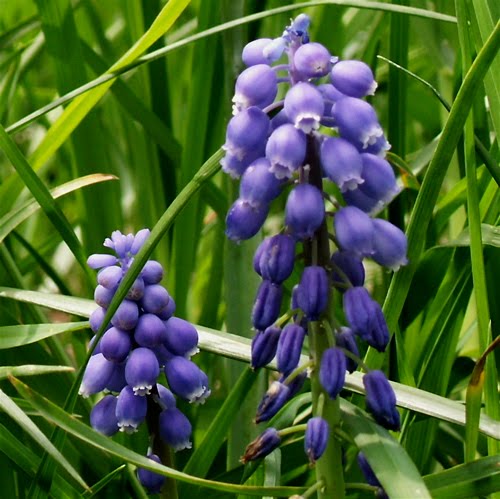
We had a touch of rain last night in Birdland, just enough to dampen the ground and release that earthy rain smell. The dogs and I walked down the grass waterway to look at the blooming Plum trees on the edge of the field. Yep, they’re blooming, all right. The petals are starting to snow down into the grass, leaving furry asterisks of stamens, and, let’s hope, the germs of many wild plums. Birdland is rich in blossoms right now—the Lilacs remain crisp and aromatic even as the Peony buds swell. The fruit trees in the yard are covered with blooms, the Apples that our friend, Brian, pruned; Pears; Cherries; Peaches; and especially the ancient Quince tree. Grandma’s yellow roses have only the tiny beginnings of buds yet, but the Sweet Rocket is sending up little bluish clusters that will soon open into a riot of violet heads, and Iris has sent up stalks with white, papery sheaths, getting ready to unwrap the present of a bud inside. Weeds are coming up, too, and I’m continuing the experiment I began last summer: mow with the rotary push mower just around the house, and limit the mowing of the rest of the yard to three times this summer. Meanwhile, my goal is to reduce the area that needs to be mowed by expanding flowerbeds and intensively mulching. I want the yard to eventually resemble a semi-wild park with winding paths lined with flowers that lead to various corners, like outdoor rooms: the bonfire area for nighttime parties; the glider for quiet contemplation; the picnic table for meals; the pond, chicken house and vegetable coop for pleasant chores. My first path leads to the barn, and the bulbs I planted in the fall are taking turns offering their parade of color. The daffodils are drying like crepe paper, tulip petals are falling to reveal fat, juicy pistils and stamens furry with black pollen, but the grape hyacinths have popped up, taking over in defining my path.

Another big part of my experiment is to redefine “weed.” Dandelions, for example, have medicinal uses (The flowers make Dandelion Wine, for example, medicinal purposes, of course) and people do grow it as a crop for the roots (Dandelion Coffee) and the greens are very nutritious. Um…why is it a “weed?” I actually like the sunny, yellow flowers, the snowy seeds, like tiny, white, umbrellas. I remember as a child, driving across town with my dad. He was playing a puzzle game with us. As we drove down the street he’d point at the various lawns, saying, “I like that yard, but I don’t like that one.” Our job was to find the pattern and guess what distinguished the yards he liked from the ones he didn’t. I can’t remember if we finally guessed or if he gave us the key: It was the absence or presence of dandelions. (Being my dad, he liked the lawns with dandelions.) For years now, I’ve left at least three common Thistles in my flowerbed because they attract butterflies. Left alone, Thistles are majestic plants with beautiful and complex purple flowers. If you mulch around them, creating a natural frame, they look like you’ve planted them on purpose. Now, more than ever, I am hesitant to mow down any plant that may help bees and other pollinators carry on. This year around the house, the Creeping Charlie has become a ground cover by default. Yes, it’s choking out the grass, but guess what? Since I haven’t mowed there at all, it has offered up heaps of gracious, blue flowers that contrast so beautifully with the deeply green leaves. I don’t think I’ll have to mow that part of the yard at all. I think I’ll just let those few clumps of grass that have managed to push through go to seed to break up the field of blue and green. I’ve lived in the country long enough to know that if I don’t mow at all, I will wake up one day in a jungle of Ragweed and Hemlock (and I know from experience that this is not a good thing). My goal instead is to mow a little less every year. Robert Wright wrote in his New York Times “Opinionator” column, “The Dandelion King,” “the war on weeds, though not unwinnable, isn’t winnable at a morally acceptable cost.” He cites the dangers of pesticide use and advocates for a new standard for lawn care. I’d like to join him in tweaking our perception of attractiveness to incorporate a more natural and holistic beauty.

Walk in Peace; Reinvent Beauty; Blessed Be.