Sunday, September 25, 2011

CHICKEN ON THE LOOSE!


 AUTUMN SEEMS TO BE BLOWING THROUGH BIRDLAND, and I haven't quite got the hang of a cool weather closet. I pull out a sweater but find myself at the soccer game wishing I'd chosen a jacket and maybe gloves. It's suddenly damp, too, and the grass is greening up, and growing after its long weeks of stagnancy. I think I'll mow once more if I can remember how, and then put the mower away until Spring.
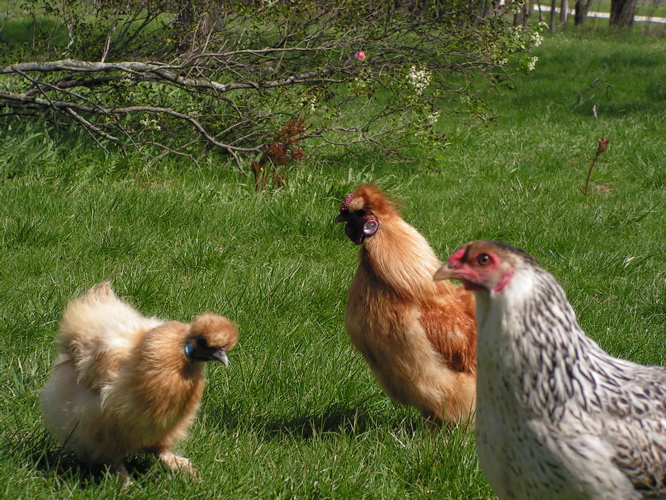
 The chickens have outgrown the aviary, and I need to transfer them to the garden coop before long. The garden coop needs a new door, which I bought several weeks ago, but is still sitting in the basement waiting for a coat of varnish. I also need to build new nesting boxes for the inside of the coop. The idea is to slowly transition them back to a free range lifestyle. I've been letting them out in the late afternoon with Ursula on the leash. She tries to be good, but she is a bird dog at heart. On the leash she seems curious and friendly, but still tries to tangle with the big rooster, who baits her constantly, though more than once she has grabbed him by his hackles and run around the yard with him. I believe she is only playing, but her play is pretty rough. He can still manage to get away from her, but I'd rather she learn that chickens are not toys.


 This morning as I was carrying food to the chickens, a little Barred Rock pullet dashed out the door as I stepped inside. Ursula was out, but occupied. I always spill a little food for her midway between the house and the chickens, to distract her from racing around the aviary, upsetting the flock. I scatter the pellets on the path, and she is quite occupied with snuffling up every last one of them, so when I realized catching the chicken would be a two person effort, I shut the door and snuck up on Ursa instead. Luck was on my side and I was able to grab her and walked her into the house before she realized the little chicken was out. “Walking” her into the house is harder than it looks. She wasn't wearing a collar, and she's too big for me to carry, so it was an awkward dance. We made it to the kitchen door, and then I called for reinforcements to retrieve my little stripped chicken.


The trick to catching a chicken is not to panic. Ursula and Ellis can outrun a chicken, but even that takes some doing. I don't stand a chance of winning that footrace. Chasing is no good. It's much better to use psychology: what does a chicken want? The chicken feed I just brought out to the coop. All of her sisters and the two roos are gathered around the feeder, clucking contentedly and greedily pecking. She wants in on the fun, but now the door is shut and she doesn't see how to get back home. If one person holds open the door and discourages the others from escaping, it's an easy matter to walk slowly counter-clockwise around the aviary, herding her toward the open door. Sometimes it takes a couple of tries, but eventually the chicken walks in, the door swings shut, we go back to the kitchen to finish our coffee and start our day. Maybe some long sleeves, a sweater. Do I need a jacket? I look up at the overcast sky. An umbrella, just in case.

Coax Beauty; Pursue Peace: Blessed Be.

Monday, September 12, 2011

TOWARD ETERNITY

FIFTEEN SPRINGS AGO TWO NEW FAMILY MEMBERS JOINED US IN BIRDLAND. My youngest, Ellis, and a small, golden puppy. Isis, a Shepherd mix, looks more like a collie with some Golden Retriever stirred in, but her mother was a Shepherd. Ellis and Isis grew together, playing and learning. Ellis learned to hear and speak and walk; Isis learned to sit and stay. She never did see the point in playing fetch. (“You want that ball? It's right over there. Don't you see it?”) Ellis developed a sense of humor and Isis perfected her fine motor skills: she could open the kitchen door by jumping up and using both paws to turn the handle. She was also an expert thief. She once pulled a whole pie off the counter where I had left it to cool. She had snapped up a quarter of it before I realized it was gone. Once after a family dinner, I went in to clean up the kitchen and saw that someone had already put the ham away. “How nice,” I thought. Next day I wanted some to make sandwiches, but couldn't seem to find it in the fridge. “Where did you put that ham?” I asked everyone, but got only puzzled looks. Nobody remembered putting it away, and it was not in the fridge. A mystery. A few days later I found what was left of it carefully buried under some hay in the machine shed. She had somehow spirited it away outside without being seen. Later that night she had tummy troubles, and we got confirmation of her guilt. Apparently she ate the string netting that surrounded the ham.

 Ellis learned to ride a bike and Isis learned that bikes coming out of the machine shed meant a good, long run. We all learned that we had to trick Isis into coming inside before getting bikes out if we wanted to go far. She loves a good run, but in later years her range grew shorter and shorter. She was getting pretty deaf, too, and slept pretty deeply, so sneaking away for her own good was getting easier and easier.


When we got the chickens, she had to learn not to chase them, and soon became a fearless protector of the birds, doing her part to keep predictors at bay. She has killed many a possum, at times even bringing down large raccoons. We could always count on Isis to keep coyotes and deer out of the yard as long as she could hear them. As she got more and more deaf, we began to find more and more sign of sneaky visitors to our yard. Isis began to get a little grumpy, and when we brought home a small, black puppy, like a little bear cub, Isis did not welcome her. The idea was for Ursula to help with the chicken protecting duties, but it took a while for Isis to warm up to the idea, and Ursula still can't always remember if the chickens are to be protected or chased. Eventually, though, the dogs became fast friends, and Ursula would encourage Isis to awaken from her deep slumber, and go outside to meet the morning. By afternoon Isis would lose some of her stiffness and my favorite time of day was coming home to see two dogs running down the lane to greet me, both tails whirling as they frolicked and cavorted. I could almost believe Isis had found the fountain of youth as she gamboled and frisked to meet my car.


 On Wednesday, only one black dog ran to greet me. I worried a little about where Isis had got to. I looked around the yard, checked my aunts' garage—during last week's afternoon thunderstorm she had wandered in there and got locked in—but the garage was empty. At supper-time I called my high-pitched, squeaky yip—the only call she can hear—but she didn't come trotting around the corner for her dinner as I'd hoped. Poor Isie has been failing for a long time, and I knew what I signed up for fifteen years ago. But I thought one morning I'd find her curled on the living room floor in a deeper sleep. It's not like her to wander by herself. I looked for days, but our house is surrounded by acres and acres of corn and beans. On Monday we found her in the grass waterway, farther than she's walked in awhile. We sat in silence considering how she is already returning to the earth. She chose a peaceful place to lie down for her last nap. I'm grateful for all of her years of friendship and faithfulness. Rest well, Sweet Isie.


Ursula still looks for her in the mornings, and doesn't like to be left at home alone. Soon we will have to think about company for her, but not quite yet.

Walk with Beauty; Rest in Peace; Blessed Be.

A CHANGE IN WEATHER


IN BIRDLAND WE'RE BACK TO DROUGHT CONDITIONS. The grass is crispy and not much is blooming, just the Rose of Sharon and a few lingering islands of Queen Anne’s Lace and Black Eyed Susans. The Jerusalem Artichoke waits in bud, and I think the next rain will encourage it. Then we’ll have a celebration of yellow outside the west window. Sedum has mild, green bunches of blossoms, ready to turn gently pink, then slowly roasting to a rusty red. The last rain topped off my rain barrel, but yesterday I was watering something and got distracted. When I went out later to fill my watering can for the inside plants, I found I’d forgotten to close the spigot and emptied all the precious rainfall into the yard. You don’t miss your water ‘til your rain barrel runs dry.

 The heat has affected our schedule, too. Ellis’ school is on early dismissal, and soccer practice has moved to 6 AM. I got a rare chance to be awakened by my youngest, instead of the other way around. We drove to the soccer field and got there before the sun. We glimpsed a part of the morning we rarely see. A neighbor’s machine shed door open wide, light spilling out into the yard—I don’t think he’ll be in the field today, but his work keeps him busy nonetheless. In town a man pulled his garbage can to the curb and hurried back to his house to get on with his morning. A few doors down a woman stood in the yard with her little white dog, waiting patiently as the dog sniffed around and carefully chose the perfect spot. 


A little later in the day, walking to Campus is like taking an expedition through a toaster oven. A small breeze blows, but it's a hot one and offers no refreshment. I look down the block for shade, planning my route by the number of trees on a street. Although I have been through this cycle many times, the heat addles my brain. I do know that pendulum will swing, the wheel of the year will turn back, but at the same time I've lost faith and I can't imagine that walking to work will be anything other than pushing through air so heavy and swampy that it feels like a physical barrier. I know that just around the corner is sweater weather, but the only corner I can see is when the sun goes down and gives us just a little respite. The weather forecast offers slivers of hope, possible showers, but always tomorrow or the next day, and these dissipate or pass us over before tomorrow arrives.


At home we open the windows as soon as the evening cools, and slam them shut in the morning as soon as it begins to heat up. We try to lock in coolness, and keep out the humidity, with a little success. I was in the kitchen, cracking ice into a bowl, when I happened to look out the window. The trees were dancing, and I somehow knew the breeze was a cool one. I ran outside, and sure enough, a cool front was blowing through. We scampered around opening windows from the top of the house to the bottom. With our double hung windows, we pull the top sash down and push the bottom one up. This pulls in the cool air, while the warm air escapes at the top. The draft cools off the entire house in no time. With the windows open we could hear the wind, and then, something even better. Thunder! A storm was blowing in. The sky darkened and the rain rolled across the bean field. It poured for about ten minutes, and then, just as quickly as it came, the sky in the west brightened and the storm moved eastward, chased by some fluffy white clouds and a blue sky. It wasn't a lot of rain, but enough to green up the grass a bit, and coax a couple of twinkling little asters into bloom. More will follow in the next few days, especially if we get a little more rain.

Dream in Beauty; Bloom in Peace; Blessed Be.

Saturday, August 27, 2011

A WALK ON THE WILD SIDE

 BOTH OF MY DOGS LOVE A WALK, but our evening route is too long for Isis, so Ursula and I have to sneak away. In Birdland, our walks down the grass waterway—a wide, green ribbon of short grass curving between the cornfields—give me a chance to see how dramatically the drought has affected the countryside here.
 
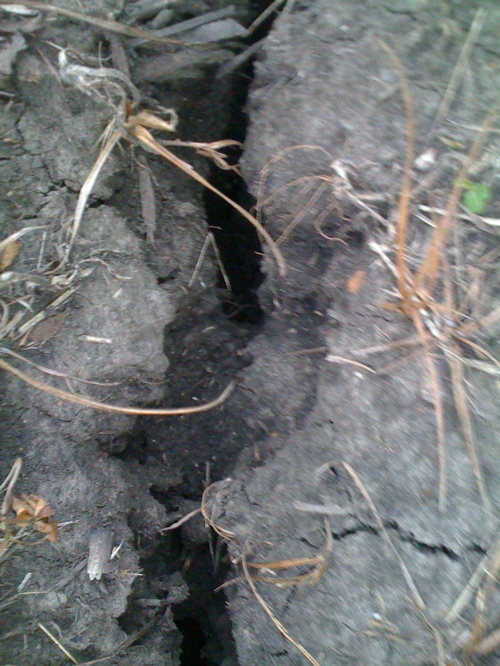
 Of course, this time of year the corn is always drying out, green fading to brown, but the ears are usually swollen, showing golden kernels where the husk is pulled back by wind or nibbled on by deer. Now forlorn ears hang from the stalks, showing gap-toothed through the brown paper of their wrappers. Some years are like that, and it makes me think of other agricultural systems, like Community Supported Agriculture, where the risk of a low harvest is shared across the community. The grass is still showing some green but any barren ground has cracks wider than I’ve ever seen them—two and three inches across, and so deep that I think I could drop a penny down and hear it hiss when it hits the earth’s molten core. The rain we got last week would have been enough in normal times, but it didn’t even close up the cracks, just rounded off the edges at the surface. They still run deep into the dark earth.
 The wheel of the year has turned again so that we get respite from the heat in the mornings and evenings, but midday is still hot. School has started, and my walking takes a different rhythm, providing food for thought. City walking takes me through a sequence of deliberation that I began many years ago, when I first started parking my car off campus to enjoy easier parking and a brisk walk to my office. My walks take me through various scenes and I’ve witnessed changes in the landscape, some for the better, some for the worse. Some days my route winds through some lovely, curving walkways away from traffic and buffered by natural plantings and waterways. Other days I walk through neighborhoods where more and more I see front lawns dedicated to native plants rather than tightly mowed grass. Once last week I came upon a yard fencing in a flock of Rhode Island Red chickens and Buff Orpington Ducks, right there in town. The poultry was happily grazing, oblivious to the people on the sidewalks. Only a soft, satisfied clucking brought my gaze to their yard. We wouldn’t have seen this ten years ago. All this is a pleasant progression for my decade of walks.


 On the other hand, I see more and more litter in the streets of Campus Town. I see more cans for recycling, but move in day brings larger and larger piles of discarded furniture at apartment complexes. One truck-sized dumpster sat next to an empty building overflowing with mattresses, cushion-less sofas, lounge chairs, appliances. Another pile sat next to it, even bigger than the dumpster and I wonder where it all came from and where it will go. We have programs for recycling and re-using and sharing the paraphernalia of our transitory existence—the web community, Freecyle, and the University Y’s Dump and Run program come to mind—and yet we seem to generate more and more rubbish every year. I wonder if the basic problem is a disengagement between what we buy and what happens to it when it is no longer useful to us. When we acquire a new toy, gadget, furnishing, do we pause for a moment to consider the cradle to grave impact our purchase will have? Do we consider the cost of disposal (not just our monetary cost, but the cost to the community of filling the landfill or abandoning things in an empty lot)?


 My walks meander through different topics and last night I found myself talking to my sister on the phone. She was on the West Coast, I was walking in the dark toward the grass waterway, looking up at the stars. It was the clearest night I’ve seen in awhile, the waning crescent of the moon nowhere to be seen, the Milky Way splashed across the sky in a broad spattering brushstroke. As we were saying our goodbyes I said, “Wait, I have to tell you about the stars. The Milky Way is just beautiful tonight.” She said, “That’s wild. It’s still daylight here.” We chuckled together about this for a moment, I under my starry, starry night, and my sister watching the golden sun sink into the peaceful ocean. Then Ursula and I headed toward home down the dark waterway.

 Walk in Beauty; Wonder in Peace; Blessed Be

Sunday, August 21, 2011

REVIVING NAKED LADIES


TODAY BIRDLAND IS PLEASANTLY OVERCAST. The sun winks through grey cloud cover once in awhile. I stepped out to grab the laundry off the line and saw constellations of dark raindrops in the dust. But when I reached the laundry, it was no more damp than this morning's dew had left it. (Yes, I left it out all night. Again.) We got rain last week, but the parched earth swallowed it up and asks for more. I've always liked this kind of sky once in awhile. It feels a bit like the protective feeling you get walking under an umbrella, or sitting in a tent listening to the gentle rhythm of raindrops. I'm hoping that gentle rhythm will come soon. I rigged up a hopeful mini-rainbarrel—the bucket from an old dehumidifier under the downspout to siphon water through a garden hose into my little pond, which is going dry.
 The Ghost Lilies, which have been reticent this summer—only a few blooming in stunted fashion here and there—had a party after last week's rain. They have popped up from all their secret spots, soft pink clusters of trumpets calling the bees with their gentle fragrance. They remind me that it's time to indulge my fascination with them—the ultimate reminder of invisible, subterranean forces that eventually blossom. I hope you are not tired of hearing about Ghost Lilies by now, because I'm not sure I'll ever be through with them.


Do you remember them? They have many names, and I've collected a few new to me in the past couple of years: Magic Lilies, Surprise Lilies, Vacation Lilies, Resurrection Lilies, Naked Ladies. They are like pale pink Amaryllis, emerging in the spring as a nubbin the size of your thumb—a tight bundle of leaves lined up like the pages of a tiny, green book. Then they grow like Jack's beanstalk, inches per hour, until they are a like a giant spray of leaves of grass, up to your knees. Except for their growth rate, they are unremarkable, just naked leaves that bravely collect sunshine for a few weeks, then, as suddenly as they came, they collapse in a yellowed heap and disappear until you see no trace, even of the wilted leaves.

We go about our summer business—weeding the garden, repairing the chicken coop, driving kids to soccer practice and swimming pools, paying bills, working, peeling peaches, trying to keep cool—and forget all about those green leaves. Then one day, when you least expect it, you walk out to the chicken coop with a scoop of food in each hand and there comes the first Ghost Lily of the summer. It wasn't there yesterday, and now it is. No leaves, only a crisp stalk with a tight cluster of elegant, long buds, like fingers. Tomorrow they will be twice as tall, and open into pink bells, long slender stamens topped with anthers full of golden pollen. One long pistil waits for the bee. Tomorrow, more stalks with more buds will follow, but look deep into the blossom. Down in the center of the bell the pink fades to a bright yellow, as if a golden light is shining up the stalk with fiber optics. And who's to say it isn't? Do we know what goes on deep in the earth in that secret bulb below? Something magical and transformative. I once dug a bunch of Ghost Lilies to spread around the yard and was surprised at how deeply I had to dig to find the bulbs. More than a foot. I was surprised at how crisp and bright the bulbs were, all the way through. (I had cut some with my shovel.)

Now play the part of the bee. Put your nose right into the bouquet and breathe in. The flower will give you a gift of fragrance and dust your nose with golden pollen. Let's sing a song of gratitude to the flower, the bee, the darkness and the light. Each part of the cycle is important, especially, perhaps, the quiet, dark, underground part. Gathering thoughts, sunshine, beauty, fragrance, creativity—ready to emerge when you least expect it.

Gather Beauty; Inhale Peace; Blessed Be.


Monday, August 15, 2011

BENEFICIAL INSECTS LIKE NATIVE PLANTS


IN BIRDLAND, WE HAVE A RESPITE FROM THE HEAT, but not the drought. I'm jealous of the rain that  Champaign had the other day, where it “poured.” I can hear my grandmother's voice complaining that “rain on pavement never did anybody any good.” Here we haven't had a drop for weeks and the yard is dusty. The flowers that have it in them to bloom anyway are shy, with spare, small blossoms, their leaves drooping.  Ghost Lilies tentatively emerge, half their usual height, the flowers smaller, tighter, only weakly fragrant. Shrubs show signs of stress. But at least it's been cool the past few days, the humidity rising up to the sky to fall as rain far away.


 This morning I went down to visit my aunts and they invited me to pick peaches. My little peach trees are all barren this year. We had a cold snap when they bloomed, and I didn't see any bees. My pear tree only has a handful of fruit.  I was surprised that my aunts' tree had peaches. Their tree has always offered an abundance of sweet, plump peaches every year, occasionally taking a year off to rest. A spring gale broke off the best half of their tree, and when I went out to survey the damage, I didn't see any peaches set on, but it fooled me. Instead of a wheelbarrow, we used a couple of grocery bags for our harvest, filling each about halfway. My Aunt Kate shook the heck out of the tree, while I tried to pick up the peaches before Ursula got them. They look just like her rubber ball, and she thought she had hit the jackpot.


The sad little harvest, while better than the nothing I thought we would get, reminded about the workshop I went to in Ames, Iowa last week. It was called “Conserving beneficial insects with native plants,” and offered by Iowa State University. The first speaker, Dr. Lisa Schulte, introduced me to a new way of thinking about our place in nature called, “Ecosystem Services.” Scientists have been using this model for awhile, but it was new to me. At first the term put me off. It sounded kind of corporate to me, like an economic term, rather than one describing nature, as if ecosystems were just put here to benefit human society, and isn't that attitude how our ecosystems got to be such a mess in the first place? But as she spoke, and showed her slides, I began to understand that acknowledging the goods and services that seem to come “free” from nature might help us acknowledge that we'd better take care of the sources of these services. For example, the bean fields outside my window are pollinated by wild pollinators. They come, as if by magic, and we harvest the beans without a thought for these seemingly “free” services. However, I know in some places farmers pay beekeepers to park hives in their orchards. Here, at least, is an acknowledgment that pollination services are worth money. What if we had to pay bees, or even hire people to pollinate the beans in our fields? Our wild pollinators do it for the pollen and the nectar, but if we don't protect their habitat, how will we attract them to our fields? Another speaker, Dr. Mary Harris, said, “It's a tough life out there for pollinators.”


What can we do to help reestablish populations of wild pollinators? We can provide diversity of native plants in our gardens, roadsides and yards. Even on our farms, according to Dr. Harris, “diversity of crops themselves can help pollinators." We can think about the needs of the pollinators. What do bees need? They need floral resources for food—pollen and nectar, throughout the season. That's how a diversity of plants can help. They need nesting spaces—undisturbed soil, wood, even hollow stems, like those left over from Day Lilies after they've bloomed, can provide shelter. Really, they just need nature. In my own yard I can encourage wild Asters and Black-Eyed-Susans that come up in my yard, banking some of the ecosystem services (pollination services, yes, but also more selfish ones. I can pick some of those flowers for my table, saving $5-$10 to fill each vase. I get spiritual benefits, too—stopping for a moment to smell, or appreciate the colors in the sun). In our yards and in our farms, even in our roadsides we can consider diversity of plant life, which supports diversity of pollinators. As we viewed slides of diversified farms, I began to imagine our own grass waterway—the lovely, green, well-clipped road through the fields built to preserve the soil—as a prairie waterway, or a bee road, hosting myriad native plants and pollinators. Imagine.

Diversify Beauty; Imagine Peace; Blessed Be.


Tuesday, August 9, 2011

THE ROAD TO WYOMING

But I promised you a ride on a horse, didn't I?
OUR CAR CAME BACK TO BIRDLAND A LITTLE THE WORSE FOR WEAR—we found a small ding in the windshield about halfway. I meant to have it fixed in Seattle, but forgot all about it until I was ready for the return trip. Then I saw it had become a full-blown crack. But in one way our car came back a tiny bit better. When I bought it and put on my new license plates, I discovered that one of the screws that holds the front plate was broken. The corroded screw prevented a new screw from attaching. I knew I could get a special tool and dig it out, but had been putting it off. If I tightened the good screw, I could straighten the plate for a while, but after driving through several states, the vibration would set it askew again.   


At a rest stop in Montana, I returned to the car to find Ellis talking to a man. My youngest is a little shy, so I was surprised to see him visiting with a fellow traveler. They shook hands as I walked up to the car. “I'll be right back,” said the trucker with a smile. True to his word, he returned with a plastic fastener. He threaded the plastic through the plate, and pulling it tight, he sliced off the end with his pocket knife. “Better than a screw,” he said, proudly, and hopped back into his truck. Once again, I'm awed by how a brush with a stranger can enrich a community—sometimes a rooted neighborhood, sometimes a linear community of travelers. My license plate has been straight all the way home.


 But I promised you a ride on a horse, didn't I. Back in Wyoming, after visiting the foals, my friend, Claire offered to introduce Ellis and me to Pockets, a gentle gelding. We are not experienced riders, maybe 5 or 6 trail rides between us, but Claire's calm advice and instruction reassured us. Ellis was first, so I got to sit back and observe. I noticed Claire's respectful manner toward the horse, even down to the vocabulary she used to teach us how to let Pockets know what we wanted him to do. As she spoke, I began to understand that her method of riding and teaching was based on respect, even reverence, for the animal. I noticed how communication between the rider and the horse (rather than a set of assumptions on the rider's part—that if I yank the horse's head this way with the reins, he will go this way; If I kick him harder he will trot.) was paramount, and the key to that communication was careful and respectful observation.


She had us notice Pockets' ears, one cocked back. She said it meant that he was paying attention to Ellis, waiting for cues. This seemed natural, and reminded me of child rearing. By “respect,” I don't mean that she lets the horse do whatever he wants to do. She made it clear what kind of behavior was acceptable, and gently corrected him when he got too pushy. I came away with the idea that the rider needs to be assertive. When the horse lets us know he is waiting for prompts, we have a responsibility to prompt him. I told Claire I wish I lived closer, so I could take lessons from her, and we sat for a moment, wishing.

After the lesson she rustled up Chris, her husband, and he gave us a demonstration of some of his training methods. They give clinics at home and away. After seeing them in action, I'd love to invite them here. We sat in chairs just outside the arena and Chris brought an unbroken horse in, an older mare. He told us that horses are social animals, and communicate with each other through body language. Having someone yank on a halter to tell the horse to go somewhere is kind of a foreign concept, but they're smart animals, so they can learn it. However, it is simpler, and more respectful if we can learn the horse's language. 

I'm thinking the road to Wyoming isn't so long after all.
Of course, I'm paraphrasing and adding my own emphasis, also writing a few weeks after the fact, so I may misrepresent some of their ideas. Neither of them said the words, “horse whisperer,” and I forgot to ask them how they feel about that term, and whether they would use it to describe what they do. But I swear, Chris got an untrained horse to walk in a circle with a small, but assertive gesture. He got her to set her feet in a certain way (like they do in a show?) just by looking at her legs. At any rate, they made me want to learn more about horses, and I'm thinking the road to Wyoming isn't so long, after all.

Respect Beauty; Communicate Peace; Blessed Be.