Monday, December 5, 2011

JUGGLING BALLOONS


 DID YOU EVER TRY TO KEEP A BUNCH OF BALLOONS IN THE AIR? We used to play at birthday parties, a kind of juggling where someone would pull back on the knot of a balloon to launch it. Propelled by its own elasticity and tension, it would rise quickly, maybe to the ceiling, and then slowly descend. The trick was to keep it from sinking all the way to the floor, and whoever was closest would bat it back up. The more the merrier—more people, more balloons, more colors. We would try to keep five, six, seven balloons in the air, a slow motion, rainbow hued juggling game. I think we called it, “don't let it touch the ground,” something creative like that. I can still see the translucent colors, hear the soft, musical plunk of the batting of the balloons. Sometimes we'd see a rhythm, an order—as one balloon rose, others would sink, but size and shape and power of the launch would each affect the speed of various balloons.
 

 I think of those balloons these days when I have so many in the air. A couple of green ones, which are my home and my yard, a sunny yellow one for my friendships, a somber blue one for work (perhaps the most complex one, with smaller, multicolored balls on the inside for the separate rhythms of my working life: reading, writing, teaching, paperwork, meetings—all moving in different patterns and speeds), a red one for my family, an orange one for bills, a white one for exercise and health, a couple of luminous ones for special things like art and spirituality. If I consider just one balloon, the game seems easy. After all, the bills are each only due once a month; I teach one class three days a week, the other two days; I only clean house before major holidays, two—maybe three times a year. On its own, each balloon sinks slowly. But considering them all together, the pace becomes frenzied. Is it any wonder I lose track? I must think I exist in couple of parallel universes. Why else do I (embarrassingly often) find that I've double booked. “Sure, we can all paint the house on Sunday.” “Why yes, I'm free on the 20th. for dinner at your house. I'll bring dessert.” If I'm lucky, I will notice the double booking before Saturday the 19th. What's almost worse is when I hit a balloon into the air and simply lose track. Last weekend I got an email from my sweet friend, Joanne. Do I have time for lunch or a coffee visit? “Of course I do!” I typed back from my home computer. “I just need to peek at my conference schedule. I'll let you know when I can meet as soon as I get to the office tomorrow.” I even starred her message so I could find it easily when I opened my email again. I drove to town, doing my best to keep those balloons in the air—planning my week's assignments and my Monday lecture as I walked to campus. I made lists, reviewed concerns, and gathered colors and scents. I passed a small flock of fat, grey and white sparrow-shaped birds. They had collected in a leafless tree growing very close to a brick wall. I tried to take their picture, but they got suspicious when I stopped and fumbled in my bag for my camera, and I found myself focusing on empty branches. Moments later, in the amphitheater next to the retention pond, I saw a hawk tearing apart its prey—pulling pieces with its beak. It too, shunned an audience, and flew with its victim to another flat rock several yards away each time I pulled out my camera. In the end, all the pictures were blurry, and I went on to work. Mondays are always full of activity, and I was tired when I found myself walking back through the park at the end of the day. The hawk had fled.


 Thursday I was making yogurt and happened to think fondly of Joanne. “It's a good thing,” I thought “that we're getting together soon.” I poured the heated milk into the yogurt maker. “Wait,” I thought. “I don't think I got back to her about when I had time to visit.” I went to check my email, and found the stars had long since sunk to the bottom of my inbox. I searched, and found her message from (gasp!) nine days ago.


Luckily, my friend has a generous spirit, and charitably overlooked my confusion. We had a lovely potluck lunch in my office. She supplied the PBJ; I brought a pasta salad. She kindly accpeted my apologies and I gratefully accepted her forgiveness.

Juggle beauty; Pass the PBJ; Blessed Be.

Saturday, November 5, 2011

A DAY IN BIRDLAND


IN BIRDLAND THE FIELDS ARE SHORN OF CORN AND BEANS. The air is crisp and chill this morning and the sky is bright blue, and empty, save the puffy white stripes of the ghosts of trips above the prairie, crisscrossing towards Chicago, New York, San Diego, St. Louis, Atlanta, all from parts unknown. Ursula tugs at her leash as we walk toward the aviary to let the chickens loose below, to cluck and strut in the yard for the day. Perhaps a traveler will look down from the window in the sky to see us, tiny bugs crawling along my green patch of lawn. My dog is friendly with the chickens, but a little too rambunctious. Maybe someday they will run together, but not today. Tomorrow it will rain, but we don't realize that yet, and go right ahead and do the laundry and hang it out on the line. Who knows how much longer we can hang it without freezing our fingertips. We hang the first load, and then, what the heck, start a second load too, of towels and bedding. Sometimes we have a little too much confidence in our ability to finish a project.

We hang the first load,
and then--what the heck-- start
a second load, too.
 The harvest is in, but Jim and Sean are out in the fields again, the big tractors crawl across the stubble in the distance, pulling tanks of fertilizer. Farmers are always busy, like bees. I hang socks and jeans and dish towels, and they dance in the breeze while the tractors crisscross the fields, and the jet trails dissapate above. The mellow weather and the gentle wind make me feel optimistic, and I go to the basement to pull red tomatoes from the upside-down vines I hung under the stairs last week. They were green when I hung them, but they ripen one by one, so quickly that I have to make sauce every other day to keep up with the basement harvest. I use the lazy, crock pot method—quarter them and puree in a blender with half an onion and a clove of garlic, pour into a crock pot with herbs to slowly cook down to a thick sauce. If I weren't so lazy I would have jars of sauce lining my pantry shelf, but instead I pour it into plastic containers to freeze. Not as picturesque, but easy-peasy. The smell of tomato sauce fills the house and makes me think of pizza, so I start some bread dough, and then the rich, yeasty aroma adds to the party atmosphere. I get lonesome for my sister, so I call her. The next thing I know, I'm walking down the road toward the grass waterway, we chat about our plan to send cookies to the kids next week. Ursula tugs at her leash and I let her lead me, so involved in my plans that I don't notice when we turn into the waterway. Suddenly I see we are in the field, and my dog is rooting up fallen ears of golden corn from the stubble and husks. I pick up a few snaggle-tooth ears, trying to carry them in the crook of my arm as I juggle the dog leash and the phone. I find more—too many to carry back—I'll have to bring a sack next time. I'll toss these ears in the yard as a treat for the chickens, maybe shell some it for winter. It would look nice in a jar.

Chicken Dark

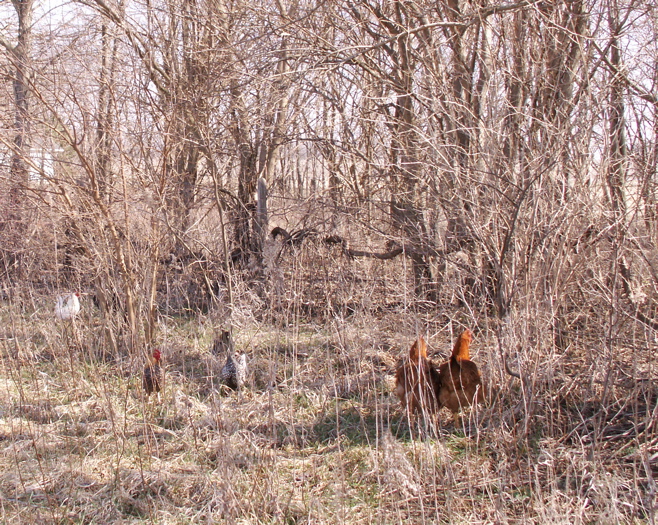
 I realize it is chicken-dark—that time of day when the chickens go in, and we turn back toward the house, going right across the field still talking with my sissy. If I hurry I can use the corn to lure the chickens back into the aviary for the night. Just yesterday we lost Michael's favorite chicken. I noticed she was missing and found a pile of light brown feathers under the apple tree where they like to roost. They go after the corn, and I count my feathered friends. I can never remember exactly how many we have, and anyway they're always moving, so I have to count like a chicken: Two roosters: check. Two barred rock, one little silver spangled: check. Only one :( light brown one left: check. Two white leghorns: check. Three French Hens (I don't know what they are, but that's what I call the three sisters): check. Yep. All there. I latch the door and let Ursula off leash. I make a fateful decision that I will regret in the morning, to leave the laundry hanging so Ursa can chase the frisbee in the darkening evening.


Count Beauty; Collect Peace; Blessed Be.

CHICKEN DARK


CAN ANYTHING BE MORE SATISFYING than getting the last chicken into the coop as the sun is going down? About half of our chickens prefer to roost high in the apple tree, so we have to encourage them in all sorts of ways to come into the safety of the aviary. One big encouragment is, of course, food. I feed them some in the morning, then let them out to scratch in the yard and they snap up all sorts of snacks—bugs; greens of Dandelion, Clover, Queen Anne's Lace; Apples; the meats of Walnuts that have been cracked by squirrels or by being backed over by the car. In fact, the flock spends the bulk of their days quietly grazing, tails up, beaks to the ground, making satisfied clucking sounds. Still, when they see me walking toward the aviary with a big, galvanized metal scoop, they'll come running. And if you haven't seen a chicken run toward you, you should come out at feeding time.
Sammy Runs


“Chicken Dark” is what we call the time of day when the sun is about to set and the chickens head back to their coop while they can still see. Chickens really do go home to roost,  but we sometimes have a difference of opinion about where “home” is. In the mornings, after Ursula has had her run, I prop open the aviary door and let the chickens out for the day. For now we can either have free-range chickens or a free-range dog. Maybe someday we'll have both, and one of these days I'll tell you about our journey toward a peaceable kingdom at Birdland. The birds have their day in the yard, while Ursula watches from the window. With careful supervision (preferably by at least two of us) she can play fetch. She is increasing her vocabulary and learning the fine distinctions between “frisbee” and “chicken.” She is also learning impulse control, and we can see it in her eyes when she is about to bolt, and take off to the chicken side of the yard. Most of the time we can redirect her, but occasionally, chaos ensues, and we run for the garden hose as a defense of chicken territory.


The flock spends the bulk of their days quietly grazing, tails up, beaks to the ground,
making satisfied clucking sounds. 


In the evenings, if I can get home before chicken dark, I carry another scoop of food, and most of the flock will follow me into the pen. A few stragglers will circle around the aviary, and this is where an extra person can help. One person can hold open the door, while the other herds the flock clockwise around the aviary. With each circle, a few more slip through the door to safety for the night. The old, red rooster gets curious and tries to come out, and that is where a rake is convenient. It's a trick to block his exit while encouraging the stragglers to come in.


If we wait too long, half a dozen of the hens will be perched in the apple tree. A few will hop down when they see me coming with the scoop, but 3 or 4 will hop up a little higher into the tree. In summer, the leaves provide a little shelter from the weather, and hide them from predators. But now the leaves are falling. We have a variety of chickens, and though a sharp-eyed owl would probably see the moonlight glinting off of the beak of one of the brown hens, we have two white ones who like to roost in the tree. Even to my failing, human eyesight they look like bright neon signs that say “Free Lunch” to any nighttime predator. The flock has thinned since they began this habit, so I do my best to discourage it. Sometimes the ruckus below gets them curious enough that they will fly down and get caught up in the frenzy of snack time, but sometimes they pretend not to notice. That's when the garden hose comes in handy.

Roost in Beauty; Shelter Peace; Blessed Be.

Tuesday, October 25, 2011

RAIDING THE NEIGHBORS' TOMATO PATCH

Birdland is full of Fall.
BIRDLAND IS DAMP AND CHILLY AND FULL OF FALL. Leaves fall, walnuts fall, rain falls, temperatures fall. Night falls early and the day comes late. Last Monday I lay in bed and convinced myself that it was so dark when my alarm went off that surely it was time to set the clocks back again. It was nearing 7, and the sky was just lightening. But when I got up to check, instead of finding I had another hour to get ready for work, I discovered we still had a few weeks left of daylight savings time, and this morning I had to pay with my hopeful thinking by rushing to get ready for the day.


I don't know if I've mentioned it, but this year I just didn't have it in me to garden. Instead, I've been keeping my eye on the tomatoes at Barb and Dave's house. They have the best tomato patch with assorted varieties. Big, chunky salad tomatoes, summery grape tomatoes, sugary cherry tomatoes. I've invited myself over to help keep them picked, and they are very generous with their bounty. The vines always seem to be full of fruit in all stages of ripeness. We've been keeping an eye on the weather, too, hoping to strip the vines just before the first frost. This afternoon I received a frantic text from Barb, asking me to come by and pick. We're supposed to get our first frost tonight. I had told her about my method of ensuring a winter's crop: just before the frost, cut the vines and hang them upside-down in the basement. The vines die, but the green tomatoes slowly ripen, and we have red tomatoes into January. They tend to get a little wrinkled on the outer skin, but they taste at least as good, or better than, grocery store tomatoes. Barb told me she wasn't going to have time to harvest, so I should go and cut all I want. I picked up Ellis and his friends and drove to Barb and Dave's. Their oldest son was home with a cozy fire, and I popped my head in to tell him I was raiding the garden. “That's what it's there for,” he said. I raided the kitchen, too, for a salad bowl and some plastic bags, and first set about picking the red tomatoes, and there were plenty. I left a big bowl of all varieties on their counter, and we filled several bags to take home. Tomorrow we'll have fresh tomato soup.


The sun was setting and the air was crisp. The fruit was cold, too, and the chill was beginning to seep into our hands. The boys thought we had plenty of tomatoes, but the hard work was ahead of us. Barb and Dave's tomato patch has lovely wooden cages, pointed at the top, like tall pyramids, and painted green. The bushes grow tall into these cages, sometimes two plants together, so that big beefy tomatoes are intertwined with the cherry or grape tomatoes. Pulling out whole plants was impossible, so we began cutting off branches and piling them into the back of my car. The boys were glad when the car was finally full to the top, but the work was still not finished.


At home I drilled hooks under the basement stairs and bundled the branches together with string to hang from the hooks. I used to hang whole plants, roots and all, from ancient nails in the joists. It worked well, but the roots brought in a lot of dust, and the plants were so big that picking the ripe ones was sometimes difficult. I hope that hanging bundles of branches will make picking easier.

Yellow Pear Tomatoes

When I finally finished it was dark, but I still wanted to gather the walnuts I've been stumbling over on the front walk. I did it mostly by feel and gathered about a bushel. I thought about how much I love the Autumn when we can reap what we sowed in the spring. And if we didn't have time to do our spring sowing? Our world is pretty fertile. We need only look around to see what is provided for us by the trees and by the generosity of neighbors.

Collect Beauty; Garner Peace; Blessed Be.

Saturday, October 15, 2011

THE HEART IS AT THE CENTER

Searching for the Center.
 IT'S A RAIN-ISH DAY, AND WALKING TO CAMPUS FROM MY CAR IS LIKE WALKING THROUGH A MIST.  I have a rain jacket in my bag, but it's not even worth pulling it out. I am enjoying the cool dampness on my face and on my hair. I cross the street and the dark pavement is slick and shiny. Golden and orange leaves are flattened against it like Autumn stickers. I'm on my way to teach, and I should be planning for my classes, but instead I'm thinking about last weekend's retreat at Lake Sara.
Shag-Bark Hickory

 I got to sleep in a luxurious room in a lake house called “Sara's Sanctuary.” The next day, a dozen or so women would join me to write, draw, walk around the grounds, eat, and share tales and strategies. They arrived around nine, and I tried my best to introduce them to Birdland through stories and pictures. Since I write these letters regularly, the act of writing has become a practice for me, something that gives my life rhythm and rhyme, and a reason to slow down and take a careful look at what is going on around me. Through this writing practice I have begun to create a quiet center in my life, one that nurtures and sustains me. I tried to share that with them and encourage them to locate their own centers. We did some childhood drawing exercises, and seeing all the different riffs on childish landscapes was fun. One woman grew up in the Pacific Northwest and drew the same snow-capped mountains I used to draw, with letter “m” birds in the distant sky. Prairie girls have a similar picture vocabulary, it seems, but I don't remember drawing saugaro cactuses, as another woman drew. One woman drew a big, smiling sun and edged the page with intricate borders and ribbons of text. Another asked for pink crayon, and drew what looked like a Seusian truffula tree, with pink, windswept foliage. We shared our drawings and talked about the personal connections we each felt with these archetypal worlds.
The surface and the depths.


After a delicious box lunch (mine was a hummus wrap) we split into small groups and went out to walk around in the woods and down to the lake, letting our cameras lead us to colors and textures and shapes: the unruly bark of the shaggy Hickory tree; a tan acorn in its brown cap, nestled in a bed of leaves; blue rippled water with trees, clouds, sky reflected in the depths, leaves sailing on the surface, stones beneath; women on the dock, talking about travel; a Hobbit hole in the base of a tree, the ancient root flowing out in brown ripples, like a river; the three leaflets of poison ivy, turned yellow and more virulent; my retreat journal laid on the dock, manilla colored poplar leaves surrounding it; a martin house on a tall pole, caught in a prism of sunlight.


Martin House

We walked and photographed and talked and then went back inside to write, each finding a private nook to record our reflections and write our own letters. The day was sunny and warm, and we found ourselves in pockets of conversations, spread around the big house, on the porch, in the living room, in the kitchen. I am grateful for the sharing of ideas and artistic communion on such a lovely day, with such a lovely group, in such a lovely space. I taught a few “parlor tricks,” ways to strengthen our writing, easy to do once you know the trick. They taught me that the simple act of gathering together with the intention of creating and sharing can help us carve out a space in our lives to fill from the center. That center can gently spread outward, like ripples on the surface of a pool.

Center in Beauty; Ripple in Peace; Blessed Be.

Wednesday, October 12, 2011

KNITTING CAMARADERIE

WHEN YOU MAKE A MISTAKE, DO YOU TINK OR FROG? Late Tuesday afternoons you can find me at my knitting group at the Brown Bag Deli just off the square. I meet with a wonderful group of women to knit and share patterns and yarn and needles, passing jokes and wisdom around the table. Sometimes we put two tables together. We have a lot of Susans.
 This week Sheree taught us some new knitting terms she learned. To “tink” is to carefully un-knit, one stitch at a time, keeping the work on your needles as you go. (“Tink” is “knit” spelled backwards.) To “frog” is to pull out whole rows at a time (rip it; rip it).
 It's fun to see what everyone is working on each week. Barb seems to create free form patterns, a stuffed giraffe for her grandson, a scarf she somehow knit around the corner, like a log cabin quilt pattern, instead of in straight rows. She's not sure where the pattern will lead her and she asks advice for the next block. Paula and Sheree have been making scarves lately, each with her own complicated style of lacy yarn-over design. Paula gave me her pattern, as well as some yarn she was tired of, and now I'm making one too—a pink wool-acrylic blend, which I think I will give to my niece. The Susans all seem to be making sweaters for babies and young children. I think on of them is making slippers: huge, bulky woolen ones to be felted down to a reasonable size.
I took a little poll, asking what everyone does about mistakes. Susan G. said, “It's scary when you start taking all the stitches off! One time I frogged it, but usually I tink it.”

Susan S. said she usually asks Sheree to fix it, but she also takes it to her husband, “and he will tink, but he can frog too.” Frogging can be scary, but it can also be exuberant. Unraveling several rows is satisfying, the pull lending a textured, almost musical, tension to the yarn, which comes out kinked like an old fashioned telephone cord if it has been locked in the stitches long enough.
 
Susan H. swears, and then she makes up her mind to embrace her fate. She leaves the mistake right there and calls it wabi-sabi. This reminds me of my pottery teacher. When someone's pot blew up in the kiln and spewed shrapnel into the rest of our pots, he'd say, “Look at these zen marks. Aren't they great?”


 We all know what Sheree does. She'll say, “Does this look like a mistake to you?” And we all say no, but she is not convinced and keeps asking. We each reassure her that it looks fine, but the next time we look, she is quietly frogging. When she doesn't know what to do she takes it town and hands it over to Bev, who can fix anything.

Our lovely Paula never makes mistakes. She was making fun of herself when she said this, but we really don't see mistakes in her careful work. She used to be very impulsive. Cuss! Rip! Now she thinks about it, analyzing where she went off track, but she still frogs it out. She and I both tried the same new modification of Granny's dishcloth, and she told me she started over about five times before she produced the lovely, lacy washcloth I saw and tried to emulate.
 
Me? I usually just keep knitting. My patterns may be irregular, but if the pattern is complex enough, I can pretend it's simply variation on a theme. The only exception is when I make the mistake not out of carelessness or dropped stitches, but because I haven't really learned the pattern. In that case I'll tink until I get back to where I know what I did wrong, and begin again.

Knit in Beauty; Tink in Peace; Blessed Be.
 

Wednesday, October 5, 2011

THE AUTUMN PALETTE

Jerusalem Artichoke

Curley Dock
IN BIRDLAND THE DAYS GROW SHORTER. Mornings are chilly and damp, and often shrouded in fog. The grass has greened up after the long summer's drought, and I still haven't pulled out the mower for that last trim. The palette has shifted again, and now the yard is full of shades of yellow, as if gathering the last bit of golden sun to get us through the winter. Jerusalem Artichoke bursts from the old grain wagon west of the house, and spikes of Goldenrod line the lane. It's not all yellow, though. Two different kinds of wild asters are scattered through the yard. One has bunches of tiny white flowers, like stars bursting from within a bush of delicate greenery. The other has broad leaves and a taller stance with pale lavender-blue flowers, a little bigger than the white ones. All of these come up volunteer in the wild, unmown parts of the yard, but we have some tame flowers, too: a dark pink Sedum from Gayle, who is so generous with her plants. These line my path to the barn and will toast to a rosy russet and then to a rich brown as winter comes. On the path is also a Chrysanthemum of deep burgundy. Its spicy smell reminds me of my grandmother's yard, where they always grew in four colors. Nanny never let me leave her house in the Autumn without taking home a big bunch of Chrysanthemums. She would wrap the stems in damp paper towels and aluminum foil to keep them fresh all the way home.


Autumn Field
 I walk out for a closer look at the sunny flowers towering over the old grain wagon, and I find a Daddy-Long-Legs nestled (kneeling?) in the center of a Jerusalem Artichoke blossom. He is either drinking the dew or munching on the pollen. But it's not all flowers blooming, either. Some are done with all that. The Hollyhocks that bloomed ever higher up the stalk in bright colors all summer long, are now dried seed cases, like little round cheeses wrapped in brown paper, holding next year's flowers in a package. Black-Eyed-Susans are now only the dark eyes, having shed their bright petals to scatter to the wind. The Curly Dock has put up its spikes of intensely brown seeds, and I cut these to add depth to a bouquet and offset the bright colors of the flowers, or to hang upside-down in the parakeets' cage for a treat.
Black Eyed Susans are all eyes

Gayle's Sedum
 The fields are drying, too, and Jim and Sean have cut most of the corn. My walk down the grass waterway is still green, but no longer sheltered with walls of corn on each side. Now, instead I can see clear to the fence-line and beyond. I suppose anyone can see me now, too, walking down the green road with my black dog. I kind of miss my sheltered lane, but it will come and go away again, as do all things in Birdland. The beans are drying to a pale brown, and will soon be dry stubble in the field.

Tonight it's windy, and a sliver of crescent moon hangs over the bean field. It is low and vast against the dark sky, like the silver earring of an immense Goddess. Tonight I feel a little lonely, thinking about the fading summer and the coming winter. The Autumn will wisely lead us to Winter with her gifts of nuts and apples and wood smoke and sweaters and cozy evenings with friends.

Preserve Beauty; Affirm Peace; Blessed Be.


Hollyhocks Gone to Seed