
We had a touch of rain last night in Birdland, just enough to dampen the ground and release that earthy rain smell. The dogs and I walked down the grass waterway to look at the blooming Plum trees on the edge of the field. Yep, they’re blooming, all right. The petals are starting to snow down into the grass, leaving furry asterisks of stamens, and, let’s hope, the germs of many wild plums. Birdland is rich in blossoms right now—the Lilacs remain crisp and aromatic even as the Peony buds swell. The fruit trees in the yard are covered with blooms, the Apples that our friend, Brian, pruned; Pears; Cherries; Peaches; and especially the ancient Quince tree. Grandma’s yellow roses have only the tiny beginnings of buds yet, but the Sweet Rocket is sending up little bluish clusters that will soon open into a riot of violet heads, and Iris has sent up stalks with white, papery sheaths, getting ready to unwrap the present of a bud inside. Weeds are coming up, too, and I’m continuing the experiment I began last summer: mow with the rotary push mower just around the house, and limit the mowing of the rest of th

e yard to three times this summer. Meanwhile, my goal is to reduce the area that needs to be mowed by expandi

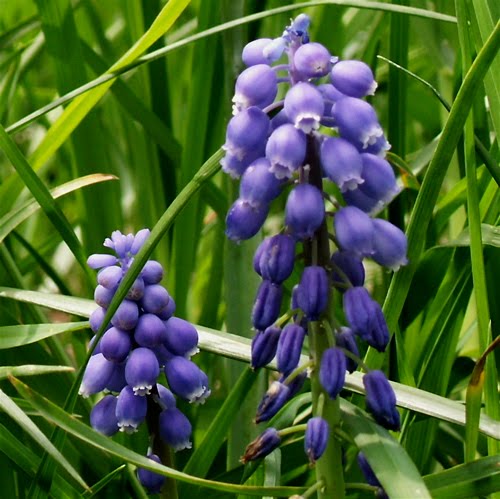
ng flowerbeds and intensively mulching. I want the yard to eventually resemble a semi-wild park with winding paths lined with flowers that lead to various corners, like outdoor rooms: the bonfire area for nighttime parties; the glider for quiet contemplation; the picnic table for meals; the pond, chicken house and vegetable coop for pleasant chores. My first path leads to the barn, and the bulbs I planted in the fall are taking turns offering their parade of color. The daffodils are drying like crepe paper, tulip petals are falling to reveal fat, juicy pistils and stamens furry with black pollen, but the grape hyacinths have popped up, taking over in defining my path.
Another big part of my experiment is to redefine “weed.” Dandelions, for example, have medicinal uses (The flow ers make Dandelion Wine, for example, medicinal purposes, of course) and people do grow it as a crop for the roots (Dandelion Coffee) and the greens are very nutritious. Um…why is it a “weed?” I actually like the sunny, yellow flowers, the snowy seeds, like tiny, white, umbrellas. I remember as a child, driving across town with my dad. He was playing a puzzle game with us. As we drove down the street he’d point at the various lawns, saying, “I like that yard, but I don’t like that one.” Our job was to find the pattern and guess what distinguished the yards he liked from the ones he didn’t. I can’t remember if we finally guessed or if he gave us the key: It was the absence or presence of dandelions. (Being my dad, he liked the lawns with dandelions.) For years now, I’ve left at least three common Thistles in my flowerbed because they attract butterflies. Left alone, Thistles are majestic plants with beautiful and complex purple flowers. If you mulch around them, creating a natural frame, they look like you’ve planted them on purpose. Now, more than ever, I am hesitant to mow down any plant that may help bees and other pollinators carry on. This year around the house, the Creeping Charlie has become a ground cover
 by default. Yes, it’s choking out the grass, but guess what? Since I haven’t mowed there at all, it has offered up heaps of gracious, blue flowers that contrast so beautifully with the deeply green leaves. I don’t think I’ll have to mow that part of the yard at all. I think I’ll just let those few clumps of grass that have managed to push through go to seed to break up the field of blue and green. I’ve lived in the country long enough to know that if I don’t mow at all, I will wake up one day in a jungle of Ragweed and Hemlock (and I know from experience that this is not a good thing). My goal instead is to mow a little less every year. Robert Wright wrote in his New York Times “Opinionator” column, “The Dandelion King,” “the war on weeds, though not unwinnable, isn’t winnable at a morally acceptable cost.” He cites the dangers of pesticide use and advocates for a new standard for lawn care. I’d like to join him in tweaking our perception of attractiveness to incorporate a more natural and holistic beauty.
Walk in Peace; Reinvent Beauty; Blessed Be.




 Posts
Posts

