Showing posts with label flowers. Show all posts

Sunday, June 30, 2013

PREPARATIONS

IN BIRDLAND THE SHOWY SPRING FLOWERS ARE ALREADY FADING. The quince, just yesterday so full of white blossoms it looked like a snowstorm hit, now is full of wrinkled, tea-colored crepe. The peaches have swapped their delicate, pink petals for green, furry marbles. The branches are so full that I'll have to pick some before they grow too big, or the branches will surely break with the growing fruit. After losing last spring’s entire crop of peaches to a late frost, this is a good problem to have. The forsythia has traded its bush of sunshine for green leaves, but we will soon have yellow again, because I went around behind the lilac bush and saw that Grandma's yellow rose is full of buds. These last only a few days, but they will be fragrant and bright.
 
Now comes the Sweet Rocket, luxurious bouquets on every stem, not quite purple, almost pink, bouncing in the wind. Horseradish answers with its shock of white florets, echoing the Sweet Rocket in shape, like a bridal veil to the bridesmaid pinks. Both are in the cruciferea family (cabbage, broccoli, radish, mustard) with bunches of 4 petaled flowers. Look closely and you'll see 6 stamens in the center of each flower. Four are long, 2 are short. Rain swells the Peony buds to tight golf balls, ready to burst forth in pink, white, magenta,  burgundy. Perhaps this year we'll see what color I brought back from Nancy's yard in Indianapolis one fall, a few years ago. We had a digging party, but she couldn't remember the shade the blossoms would be, and we couldn’t tell by the roots. The Iris sends stately stems skyward, and petals unfurl in different colors. For years we only had my grandmother's delicate, faded purple, with the soft, powdery fragrance, but a few years ago I started adding colors, from buttery yellow to a deep purple, almost black. This parade of flowers continues, and I can already imagine the Shasta Daisies that are now in buds that will come, just as the Sweet Rocket is fading.

My fiancé thinks we can never have
too many flowers.
And yet, with all these, Michael has brought home Foxglove to honor my eldest son. My fiancé (my husband by the time you read these words) thinks we can never have too many flowers, and brings home flats of trays and 6 inch buckets. Together we will plant these to border the walk to the chicken coop.

For this week our days are filled with projects--organizing and cleaning, with some modest carpentry—to make Birdland ready for our gathering of family and friends. I pull china and books off of shelves and vacuum the thick dust—almost a pelt behind some of the china on the high shelves—while Michael scrapes grout from the shower, replacing some tiles. We have indoor chores and outdoor chores, items to get rid of to make way for fresh beginnings.
  
Live in Beauty; Love in Peace; Blessed Be.
As we sweep away the dust, may we sweep away misunderstandings and regrets. As we clean the windows, may we open up our lives to the sunshine and warmth of friendship and the fresh breezes of laughter. As we rearrange furniture, let us open our hearts and minds to fresh ideas. As we put up tents and hang hammocks for the party, may we create comfort for each other, for our children, offer shelter for our family and community. As we string lights in the trees, may we illuminate our hearts and souls, that we may appreciate the good in each other, and see our faults by the generous light of love.

Thursday, May 31, 2012

PAUSE BRINGS TEMPORARY CONFUSION

I FEEL A BIT DISORIENTED.
IN BIRDLAND WE ARE TAKING A PAUSE. One hectic cycle has suddenly ended and I feel a bit disoriented, like the Ferris Wheel has just stopped, and I have stepped off. The world still seems to be turning, but I am now looking around at a new view, wondering where to go next.


CURLING CREPE
OF CALYX

In my confused state I cast around for a topic to write about. Should I tell you about the chicks? Growing healthy and into their adult plumage, tiny feathers along their shoulders and backs and wingtips. The Auracanas, contrary to expectation, are growing tail feathers. It's warm enough now, that they can be outside all day without the lamp, but I'll leave it on a few days yet, for comfort. I still bring them in at night for protection, but they'll soon graduate to the big coop for the nights. It's more secure than the chick creeper. I find myself obsessively counting them every time I move them or visit. Yep, 4 of the yellow Orps, 4 of the Rhode Island Reds, 4 Auracanas with their funny muttonchops. But you're probably tired of hearing about the chicks by now. 
IRIS IS ON HER WAY OUT


Should I tell you what's blooming? Iris, I'm afraid, is on her way out. I know I should deadhead the stalks, but I find myself staring in stunned appreciation of their post-blooming state. The calyx of each flower has dried to an antique crepe, cupping the space which held a lovely flower just a few days ago. Some wilted flowers still hang on, and I'm fascinated with these faded blooms, curling inward as they dry, the pale, lavender color of the petals fading to a spidery blue. I once worked in a bakery and we had a bouquet of Gladioli. They were lovely in their blooming, but just as lovely as they faded. I left them there in the vase on the counter until a woman came in and told me that they were past their bloom. The baker and I chuckled about it later. I emptied the vase and hung the flowers upside-down behind the counter. They kept their beauty for a long time. In my yard, Peonies won't be far behind the Irises, though they're mostly still bright and bushy. Daisies are still fresh for awhile, yet, and the day lilies are still in bud. Always something is fading while something is just ready to open. But you are surely tired of hearing about the flowers.


Suddenly, with this great pause, I can think about getting my house in order. The breakfast dishes are waiting, and some from last night. The knives are laid on the counter waiting to be carefully washed and honed. 

My boys gave me a nice set of knives for my birthday. They told me they were tired of the dull ones I've always had. I never learned to hone knives, but I want to keep these nice, and it's really easy. The rituals of domestic tasks always seems meditative to me. Hanging laundry on the line—shaking each item to soften it and get rid if wrinkles is like shaking the troubles from my head. Sweeping the floors is like pushing my problems into a manageable pile; and yes, even washing dishes helps me focus and plan my day. I wash and dry each knife carefully, and then hone it like my boys showed me. Taking good care of a gift my sons gave me feels like I'm taking good care of them. But I'm very sure that you're tired of hearing me talk about my domestic chores.


WHAT NEXT?
 No, I don't know what to write about this week, and I hope you'll forgive me while I stand her for a moment, blinking in the sun, trying to decide what ride to try next.

Wednesday, May 2, 2012

THE ARCHITECTURE OF MEMORY

One lone early bloomer turns her face to the sun.
IN BIRDLAND, THE POPPY FIELD IS READY TO BLOOM. On the end of each curving, hairy, stalk is an olive shaped bud that wants to crack open revealing scarlet crepe. Poppies seem so primordial to me. A simple two part calyx holding the full-skirted petals tightly. They remind me of prehistoric birds with long, skinny necks, sparse hair instead of feathers. One, lone early bloomer turns its head toward the sun, a flamenco dancer waiting for partners. A few buds teasingly show just the ends of their skirts. When we moved out here 25 years ago, the circle of poppies was small, maybe 4 feet across. Each year it expands and now it reaches almost from the Lilacs to the Redbud.
 
 Edging the house, my grandmother's pale purple Irises bloom, scenting my morning walks. Along my path to the barn, though, I have been planting Irises from various sources—friends and a visit to an Iris farm up north. These are a variety of colors and shapes, and I can't remember what I planted where. Some are fall blooming, but this morning two new ones are climbing out of their shells. 
 I can hardly wait to see the blossoms. The one has big fleshy buds, the sepals edged in burgundy, like exotic snails. The other is smaller, the petals beginning to turn a deep purple.
Grandma's Yellow Rose
 We have two new additions to our yard. Last weekend, in a private ceremony of reconciliation, Michael and I celebrated some of the complexities of our long association by planting a Rose and a red Maple tree. We were thinking about how to commemorate our reunion. We knew we wanted to plant something—maybe a tree, and that Malvina Reynolds song started singing itself in my head: “If you love me, if you love, love, love me/Plant a Rose for me. If you think you're gonna love me a l-o-n-g time/Plant an apple tree.” I voted for the Rose, and Michael wanted a Maple—one that would turn red in the fall. 

Iris Bud
 We ended up buying both. The Rose was already in full bloom, and the tag promised blossoms “from frost to frost.” We planted the Rose on one side of my path, and the Maple stands a little away, on the other side, so it won't shade my Irises too much. 
If you love me, plant a rose for me.
 We can see them both from the window. Our dear friend, Pastor Janet, was with us, and we showed her around the yard. I told her about the yellow Rose, blooming now, that my grandmother remembered as a tree when she was a girl, when the Lilac was just a little upstart bush. Now, of course, the gnarled Lilac tree towers over the Rose, which blooms anyway in its shadow.
If you think you're gonna love
me a long time,
plant a maple tree.
 Janet remarked about the importance of stories that connect us with our home. She said that someday our children would tell their children the story of the Rose and the Maple tree. I look around the yard and I find it is full of stories. Ghosts of five little kids greedily pluck mulberries from the tree at the side of the lane. They stain their fingers and their mouths. Over there is a young mother, planting the twigs she bought mail order, now an unruly hedge of Forsithia, Weigela, Rose of Sharon. In back, near the new Rose, my grandfather plants grapes; twenty years later a young father crafts an arbor for them to climb, with posts of Locust and boards of Cedar. Grandpa's twin cherry trees are now ghosts themselves, after living out a long life, generous with pies. A young peach tree now stands in place of the cherries. In the evenings, if we are quiet, we can see the spinney of woods that grew up between the two houses fade. Wait. The field will return and five little kids will run through the waist high grass, chasing the fireflies that rise like wishes to the sky. This emotional landscape, this architecture of memory, holds these stories for us, connecting us to our past, to this land, and to each other.


Remember Beauty; Recollect Peace; Blessed Be.

CALL ME ISHMAEL

And I alone survived to tell thee.
SPRING IN BIRDLAND MEANS CYCLING THROUGH LIFE IN RAPID SUCCESSION. On any given day in the spring we have flowers in bud, in bloom, and already gone to seed. Some, having lived out their cycles are already dying, or sinking back into the earth to wait for next year. Some species, like Dandelions, are doing it all at once—tight buds; sunshiny blooms; starry seed puffs; and the sad, empty stalks, like pencil erasers, already forgetting their previous splendor. We've already said goodbye to the early spring blossoms—Lilac, Redbud, Tulips, Daffodils, the bush in the front yard that I mistakenly call Weigela every time it blooms, but it is really a coral pink Rose of some type, no spines, but the Rose family's flowers of five regular petals. Now that the Weigela bush is really blooming, I remember that it's a different flower altogether, and looks nothing like the lush, spherical bush in the front yard.


Now comes the bluish-pink Sweet Rocket and its albino cousin, Horseradish. Yes! Horseradish is one of my favorite flowers, all decked out in bright white lace, like a wedding party, the leaves below in thin green tendrils now, like festive party streamers. In a few weeks those will grow into massive leaves with a sinuous curvature—just in time to fill out a tall bouquet of Day Lilies and Cat Tails. The Iris surrounding the house are just about to break into bloom, already a few early blossoms are sending out their delicate, powdery scent.


But flowers don't offer the only visitation to our yard. We've been hosting an unwelcome guest, too. A hungry varmint, probably a raccoon, has been breaking into my little chick creeper. Each time I would fortify it more strongly, but to no avail. One night we came home late to find one little Rhode Island Red pullet wandering around the yard. Did she know what was about to happen? I opened the top of the chick creeper and felt in the dark to see if the other chicks were already in bed. They were, and I popped the last little chick in the box, and closed up the both lids, laying heavy rocks and bricks on top. In the morning I woke to a mostly empty coop, just a pile of black and white feathers from the Barred Rocks. The brute had dug underneath and dined in the privacy of the chick creeper. All my fortifications were wasted. A few hours later, however, I heard a little peep-peep-peep-peep-peep. Out from the bushes came running my little Rhode Island Red. I named her Ishmael, and put her in with the big chickens. That was a week ago, and she's still traumatized. She spends her days in the dark coop, only coming out when I visit. Then she will run out and circle my feet like a cat until I pick her up and put her on my shoulder. I tell her she needs to get some sun, scratch in the yard and grow big and strong. I take her to various places where the grass is succulent and the bugs are abundant, but the next time I go to check for eggs, there she will be in the dark.


Meanwhile, I will fortify the chick creeper with stronger chicken wire, and maybe let one of the hens set some eggs in there as a last ditch effort to increase the flock a little against predation this summer. I find that the best kind of incubator is a hen, who will also be the brooder. No need to keep the hatchlings warm with lights—she will warm them with her generous, feathery insulation.


They will grow fat on bugs and grubs.
  She'll also teach them the ropes of scratching and other chicken behavior. She'll protect them from the bullying of the big chickens, and they will grow fat on bugs and grubs and the varied diet of a free range chicken.
Bloom in Beauty; Scratch in Peace;
Blessed Be.

Sunday, May 2, 2010

Garbage Old and New


Birdland is windy enough today that I think twice about hanging laundry before deciding to go ahead, using four pins instead of my usual three. The wind is warm, but the house has a residual coolness left from the spring chill of the past few days. I’m not complaining; I know that soon enough we’ll wish for a break in the heat. The flowers seem to keep a while longer than usual in this mild spring. Lilacs are just now fading, and Iris blossoms linger in their spiral wrappers. Grandma’s yellow roses have sent out small, tight bud. I have to remember to check often, because they hide behind the big lilac bushes, and only last a day or two.

We moved the chicks from the aviary to the chick creeper, where they can enjoy fresh grass. Today I’ll move the birds from the indoor winter aviary to their summer home. The chicks can venture out of their low, creeping coop, but can duck back inside if the big hens come to bother them. The Maples are dropping their helicopters and the leaves are pushing out. In just a few weeks the winged seeds grew from tiny, green mustaches to straw colored commas swirling down from the sky. I scoop them out of the little pond, but they still spiral down to float on the dark water.

The wind picks up and the dogs and I head for the woods. The Spring Beauty, Dutchman’s Breeches, and Dogtooth Violets that carpeted the forest floor a week ago are mostly gone, but the triple leaflets of Jack-in-the-Pulpit push through the fertile mulch. The double umbrellas of the 2nd year Mayapple now each shelter a yellow flower. Ursula tugs at her leash and we make our way through the Teats Timber where we harvested lumber last fall. The undergrowth hasn’t come back yet, and the walking is easy, even with a leash. We come upon the little stream where folks used to dump trash. After a good rain, we can often find old bottles. I’ve been pulling antique glass out of that gully for years, and I keep thinking I’ve found most of them, or at least most of the best ones, but today, right on the surface are a cobalt blue Milk of Magnesia and a ketchup bottle—both perfectly whole and predating screw caps. I pick these up and carry them home thinking about trash, and especially plastic. I’m sure the people who dumped these bottles never imagined I’d one day comb these woods searching for treasures. Today’s trash is another story. I find plenty of modern garbage, too, which will never be any good for anybody. Water bottles, soda bottles, a child’s car seat have been washed down that gully too, thrown casually or deliberately from a passing car.

My mind returns again to that Pacific Garbage Patch, the plastic island of floating debris. For years I’ve been patting myself on the back about garbage. Most weeks we don’t generate enough garbage to fill our trash barrel. We recycle and try to buy things second hand. In the grocery story, I consider my purchases carefully: how much packaging comes with this product? I’ve never ever bought plastic garbage bags, using instead the plastic grocery bags that somehow collect in my kitchen even though I try to be diligent about bringing my own bags, or requesting paper, or even using the trick my friend, Mary B. taught me. When I’ve forgotten my canvas bags, I’ll put my groceries back into the cart without bags. It’s an easy transfer from the cart to the car, and at home, I can grab the bags from the kitchen to unpack. I’ve had some weird looks at the checkout counter. I think they’re getting used to me now, but back to the inappropriate self-congratulation. Until those grocery bags are biodegradable, they, too, might end up in the floating mass of plastic soup that could very well lead to our destruction. I know I can do better. No, I’ve never bought garbage bags, but I can stop buying plastic sandwich bags, freezer bags, stop using the free bags in the produce section to bag veggies. I can use more permanent containers and wrap Ellis’ lunchtime sandwiches in waxed paper, closed with a small piece of tape.

The dogs and I walk back to the road. I’m clutching my bottles, planning new challenges for myself. What if I went one month without buying anything with unrecyclable plastic? What if I did some investigation to find out how much of the plastic I take to the recycling drop off actually gets recycled? We’re all in this together. Small but important steps in the right direction may put us on the right path and give us courage to take large ones.

Walk in Beauty; Work in Peace; Blessed Be.

Thursday, April 22, 2010

Reinventing "Weeds"


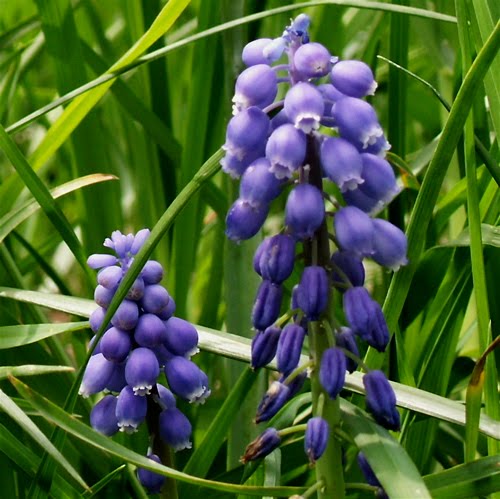
We had a touch of rain last night in Birdland, just enough to dampen the ground and release that earthy rain smell. The dogs and I walked down the grass waterway to look at the blooming Plum trees on the edge of the field. Yep, they’re blooming, all right. The petals are starting to snow down into the grass, leaving furry asterisks of stamens, and, let’s hope, the germs of many wild plums. Birdland is rich in blossoms right now—the Lilacs remain crisp and aromatic even as the Peony buds swell. The fruit trees in the yard are covered with blooms, the Apples that our friend, Brian, pruned; Pears; Cherries; Peaches; and especially the ancient Quince tree. Grandma’s yellow roses have only the tiny beginnings of buds yet, but the Sweet Rocket is sending up little bluish clusters that will soon open into a riot of violet heads, and Iris has sent up stalks with white, papery sheaths, getting ready to unwrap the present of a bud inside. Weeds are coming up, too, and I’m continuing the experiment I began last summer: mow with the rotary push mower just around the house, and limit the mowing of the rest of the yard to three times this summer. Meanwhile, my goal is to reduce the area that needs to be mowed by expanding flowerbeds and intensively mulching. I want the yard to eventually resemble a semi-wild park with winding paths lined with flowers that lead to various corners, like outdoor rooms: the bonfire area for nighttime parties; the glider for quiet contemplation; the picnic table for meals; the pond, chicken house and vegetable coop for pleasant chores. My first path leads to the barn, and the bulbs I planted in the fall are taking turns offering their parade of color. The daffodils are drying like crepe paper, tulip petals are falling to reveal fat, juicy pistils and stamens furry with black pollen, but the grape hyacinths have popped up, taking over in defining my path.

Another big part of my experiment is to redefine “weed.” Dandelions, for example, have medicinal uses (The flowers make Dandelion Wine, for example, medicinal purposes, of course) and people do grow it as a crop for the roots (Dandelion Coffee) and the greens are very nutritious. Um…why is it a “weed?” I actually like the sunny, yellow flowers, the snowy seeds, like tiny, white, umbrellas. I remember as a child, driving across town with my dad. He was playing a puzzle game with us. As we drove down the street he’d point at the various lawns, saying, “I like that yard, but I don’t like that one.” Our job was to find the pattern and guess what distinguished the yards he liked from the ones he didn’t. I can’t remember if we finally guessed or if he gave us the key: It was the absence or presence of dandelions. (Being my dad, he liked the lawns with dandelions.) For years now, I’ve left at least three common Thistles in my flowerbed because they attract butterflies. Left alone, Thistles are majestic plants with beautiful and complex purple flowers. If you mulch around them, creating a natural frame, they look like you’ve planted them on purpose. Now, more than ever, I am hesitant to mow down any plant that may help bees and other pollinators carry on. This year around the house, the Creeping Charlie has become a ground cover by default. Yes, it’s choking out the grass, but guess what? Since I haven’t mowed there at all, it has offered up heaps of gracious, blue flowers that contrast so beautifully with the deeply green leaves. I don’t think I’ll have to mow that part of the yard at all. I think I’ll just let those few clumps of grass that have managed to push through go to seed to break up the field of blue and green. I’ve lived in the country long enough to know that if I don’t mow at all, I will wake up one day in a jungle of Ragweed and Hemlock (and I know from experience that this is not a good thing). My goal instead is to mow a little less every year. Robert Wright wrote in his New York Times “Opinionator” column, “The Dandelion King,” “the war on weeds, though not unwinnable, isn’t winnable at a morally acceptable cost.” He cites the dangers of pesticide use and advocates for a new standard for lawn care. I’d like to join him in tweaking our perception of attractiveness to incorporate a more natural and holistic beauty.

Walk in Peace; Reinvent Beauty; Blessed Be.

Friday, April 16, 2010

Dragon Tail Soup


Birdland is quiet this evening. Ursula is on an overnight stay at the hospital for a little procedure. I got a call this afternoon reporting that my puppy is just fine, if a little groggy, and she had a pedicure while she was napping. We went to town early this morning and had a nice walk while waiting for the vet to open up shop. Most of our walks are in the country, so whenever we hike in town I like to look around and think about an alternate lifestyle where I might wave to my neighbors as I walk downtown for a cup of coffee or a bank errand. I shamelessly peer into yards for landscaping ideas, and gaze into gardens for color combinations. I saw a rounded dogwood tree bursting with crisp, pink petals. An elderly couple nodded to me as they shared a brisk morning walk. A man practiced his golf swing at the head of his driveway. Recycling buckets lined the curb awaiting pickup. The lawns were fresh and trim and green. Ursa needed an empty stomach for her surgery and hadn’t eaten since the night before. She was snapping at the grass and trying to root in the soil. When our walk ended at the vet’s office, I told them we had an emergency; Ursa was surely going to die if she didn’t get her breakfast soon. She trotted naively to her fate, and I went on with my day.

It was a lovely town walk, but when I got home I wondered at my envy. The warm weather is coaxing the blossoms out of their jackets and new colors emerge from the calyx to decorate Birdland. The gentle pink of Redbud harmonizes with the purples of Violets and Ground Ivy. The Lilac bushes, white and lavender, add their soft scent to the breeze. Weigela scatters flashy magenta petals in the grass to set off the Violets. I spent the day trying to work at my desk, but accomplished little, because I kept finding myself outside. “I’d better check on those chicks,” I’d think, and leave my typing mid-sentence. Half an hour later I’d come to, and find myself examining the bluebells I’d transplanted in the little spinney of woods several years ago. They are just beginning to bloom, and spreading nicely.

I don’t know how the day disappeared, but suddenly it was dusk, and I went out to check the chickens and close up the coop. I passed the asparagus patch on the way to the aviary, and though I’m sure I saw no hint of shoots yesterday, now they were two feet tall, and more. A handful was too far gone—already branching out and turning woody. Darkness was falling fast, and a moon hung in the Western sky like the tiniest sliver of cantaloupe. I went in and grabbed a flashlight and a sharp knife, then called for Ellis, since I could not juggle both with the asparagus. My youngest came along, grumbling only a little. He held the light for me while I cut them close to the ground, like Nora suggested last spring. We also checked the rogue patch by the bonfire pit, but those had not yet surfaced. I carried my green bouquet to the kitchen. If you bend the stalk it will snap at the perfect point to separate the tender part of the shoot from the tough base. Too bad we’d already eaten. I put the shoots in a vase of water, mixing the feathery, overgrown stalks with those still scaled on the tip like the tail of a lizard. Tomorrow we’ll have dragon tail soup.

I’ll pick up Ursula tomorrow. I miss her, but I appreciate the tranquil house tonight. Kali, the ghost kitten calls from the basement. I set her dishes of food and water in the kitchen and urge her to come up for her supper. Emboldened by the absence of canine (Isis is asleep in the living room), she stays a little longer, tolerating, for a while, my mindless soliloquy.

Walk in Beauty; Eat in Peace; Blessed Be.

Mary Lucille Hays lives in Birdland near White Heath. Birdland now has a fan page on facebook.

Dragon Tail Soup

Snap fresh asparagus into 2 inch lengths, reserving the tips. Steam the stem ends gently, just until they are the color of spring grass. Now steam the tails (I mean, tips) while you puree the stems with a little water, stock, cream, milk, or yogurt. Pour in bowls and drop in tails. Garnish with yogurt, sour cream, and fresh herbs of your choice. Enjoy!