Showing posts with label spring. Show all posts

Sunday, March 27, 2016

RECOVERY SOUP IN THE BIG CITY

Sister Spring in the Big City
SPRING HAS ALREADY COME TO BIRDLAND. The grass is greening up and daffodils are blooming. The velvety buds of Maple give just the lightest blush of red to the still leafless branches. Lilacs are pushing out their bright green leaves and the blossoms will soon follow. The Ornamental Quince has tiny buds, like rose colored capers, dotting the bush. The Sedum still has last year's russet bouquets, but it's time to cut those away to make way for the green leaves coming up at the base of the plant. I've got work to do in the yard today, but just now, standing at the kitchen window, waiting for the milk to boil for yogurt I see a parade of White Tails run across the still barren field into this broad morning. The dogs are sleeping at my feet, and good thing, or they would take off after, and follow the deer to the next county.

daffodils trumpet the dawn
Yesterday Michael and I went up to Chicago to visit our middle boy, Dylan. He was having an event, a "pop up" he calls "Recovery Soup at The Dinner Table." He hosts this monthly meal at a neighborhood bar, called "The Double." For just six dollars you can get a cup of soup and a hunk of a crusty hearth bread. For every cup sold, $2 will benefit a local organization. This month's was the Greater Chicago Food Depository.  


We went up early, to spend a sunny day walking around with our red-haired boy. We didn't have a plan, just walked around the neighborhood. We happened upon an art show at the Logan Square Comfort Station, the only one remaining. The web site tells us that nine identical comfort stations were built in the 1920's for use as a "warming buildings/public restrooms." I like the term, "comfort station," and the hospitality it suggests. I like even more that this was a public building. Rich and poor alike need a place to get warm and use the restroom. This one escaped demolition, and is now an art space. A Tudor style cottage with, yes, public restrooms, but also an art and performance space. We narrowly missed hearing live music—happened by just in time to see the musicians packing their cases. Next time we'll check out the website before we decide just how to spend an afternoon. At least we got to see the art, some interesting concept pieces made from various residues. We walked around and chatted. 

When we were hungry we found a place for a little lunch (saving room, of course, for the main event of the evening, Dylan's soup). We discovered a new brewery, and tried some of their beers. People met friends and played Scrabble and Jenga at a brewhouse called Hopewell. A group came in with a trio of Corgis on leashes. Another group greeted the dogs, and their people too. We went back out to discover more of the neighborhood. When we found an interesting shop we went in and browsed. We saw locally produced artful jewelry and clothing. We found a bike shop still open a few minutes after its posted closing time. "Sure! Come on in," they said when we asked. I bought a tiny brass bell for my bike. It gives one, clear, zen-like peal when I pull back the action. Dylan pointed out a shop window with a funny sculpture. I didn't see a title, but I think of it as the Goddess of Spring. She had feathers and flowers in her multi colored hair. Her arms were made of slinkies, (a fun, visual pun) and her hands were rubber gloves (spring cleaning, anyone?). In one hand she held a nest, in the other a snowman peered out of a cloud of puff of polyester fiber, suggesting a cloud or a snowbank. Her body was branches wrapped in colors and blooming in flowers. Birds perched on various parts of her. Dylan said that the sculpture in the window changes occasionally, and that it's fun to see what's new. It was a friendly kind of wandering on a sunny day.
Wander in Beauty; Sup in Peace; Blessed Be
Next it was time to pick up the soup for the event. We made ourselves useful by driving and then watched Dylan set up. Soon the soup was hot and friends and strangers alike were coming in for a hot cup. This month's was a hearty vegetable. Big chunks of still slightly crisp vegetables, plus a garnish of parboiled bitter melon and carrots, gave the soup a spring-time crunch. Chunks of something with a citrusy flavor intrigued me, and I had to ask Dylan what it was: daikon. We ate our soup and then headed home, but we'll be back next month. I can't wait to taste what Dylan will make next time.
Wander in Beauty; Sup in Peace; Blessed Be.

Wednesday, May 2, 2012

THE ARCHITECTURE OF MEMORY

One lone early bloomer turns her face to the sun.
IN BIRDLAND, THE POPPY FIELD IS READY TO BLOOM. On the end of each curving, hairy, stalk is an olive shaped bud that wants to crack open revealing scarlet crepe. Poppies seem so primordial to me. A simple two part calyx holding the full-skirted petals tightly. They remind me of prehistoric birds with long, skinny necks, sparse hair instead of feathers. One, lone early bloomer turns its head toward the sun, a flamenco dancer waiting for partners. A few buds teasingly show just the ends of their skirts. When we moved out here 25 years ago, the circle of poppies was small, maybe 4 feet across. Each year it expands and now it reaches almost from the Lilacs to the Redbud.
 
 Edging the house, my grandmother's pale purple Irises bloom, scenting my morning walks. Along my path to the barn, though, I have been planting Irises from various sources—friends and a visit to an Iris farm up north. These are a variety of colors and shapes, and I can't remember what I planted where. Some are fall blooming, but this morning two new ones are climbing out of their shells. 
 I can hardly wait to see the blossoms. The one has big fleshy buds, the sepals edged in burgundy, like exotic snails. The other is smaller, the petals beginning to turn a deep purple.
Grandma's Yellow Rose
 We have two new additions to our yard. Last weekend, in a private ceremony of reconciliation, Michael and I celebrated some of the complexities of our long association by planting a Rose and a red Maple tree. We were thinking about how to commemorate our reunion. We knew we wanted to plant something—maybe a tree, and that Malvina Reynolds song started singing itself in my head: “If you love me, if you love, love, love me/Plant a Rose for me. If you think you're gonna love me a l-o-n-g time/Plant an apple tree.” I voted for the Rose, and Michael wanted a Maple—one that would turn red in the fall. 

Iris Bud
 We ended up buying both. The Rose was already in full bloom, and the tag promised blossoms “from frost to frost.” We planted the Rose on one side of my path, and the Maple stands a little away, on the other side, so it won't shade my Irises too much. 
If you love me, plant a rose for me.
 We can see them both from the window. Our dear friend, Pastor Janet, was with us, and we showed her around the yard. I told her about the yellow Rose, blooming now, that my grandmother remembered as a tree when she was a girl, when the Lilac was just a little upstart bush. Now, of course, the gnarled Lilac tree towers over the Rose, which blooms anyway in its shadow.
If you think you're gonna love
me a long time,
plant a maple tree.
 Janet remarked about the importance of stories that connect us with our home. She said that someday our children would tell their children the story of the Rose and the Maple tree. I look around the yard and I find it is full of stories. Ghosts of five little kids greedily pluck mulberries from the tree at the side of the lane. They stain their fingers and their mouths. Over there is a young mother, planting the twigs she bought mail order, now an unruly hedge of Forsithia, Weigela, Rose of Sharon. In back, near the new Rose, my grandfather plants grapes; twenty years later a young father crafts an arbor for them to climb, with posts of Locust and boards of Cedar. Grandpa's twin cherry trees are now ghosts themselves, after living out a long life, generous with pies. A young peach tree now stands in place of the cherries. In the evenings, if we are quiet, we can see the spinney of woods that grew up between the two houses fade. Wait. The field will return and five little kids will run through the waist high grass, chasing the fireflies that rise like wishes to the sky. This emotional landscape, this architecture of memory, holds these stories for us, connecting us to our past, to this land, and to each other.


Remember Beauty; Recollect Peace; Blessed Be.

CALL ME ISHMAEL

And I alone survived to tell thee.
SPRING IN BIRDLAND MEANS CYCLING THROUGH LIFE IN RAPID SUCCESSION. On any given day in the spring we have flowers in bud, in bloom, and already gone to seed. Some, having lived out their cycles are already dying, or sinking back into the earth to wait for next year. Some species, like Dandelions, are doing it all at once—tight buds; sunshiny blooms; starry seed puffs; and the sad, empty stalks, like pencil erasers, already forgetting their previous splendor. We've already said goodbye to the early spring blossoms—Lilac, Redbud, Tulips, Daffodils, the bush in the front yard that I mistakenly call Weigela every time it blooms, but it is really a coral pink Rose of some type, no spines, but the Rose family's flowers of five regular petals. Now that the Weigela bush is really blooming, I remember that it's a different flower altogether, and looks nothing like the lush, spherical bush in the front yard.


Now comes the bluish-pink Sweet Rocket and its albino cousin, Horseradish. Yes! Horseradish is one of my favorite flowers, all decked out in bright white lace, like a wedding party, the leaves below in thin green tendrils now, like festive party streamers. In a few weeks those will grow into massive leaves with a sinuous curvature—just in time to fill out a tall bouquet of Day Lilies and Cat Tails. The Iris surrounding the house are just about to break into bloom, already a few early blossoms are sending out their delicate, powdery scent.


But flowers don't offer the only visitation to our yard. We've been hosting an unwelcome guest, too. A hungry varmint, probably a raccoon, has been breaking into my little chick creeper. Each time I would fortify it more strongly, but to no avail. One night we came home late to find one little Rhode Island Red pullet wandering around the yard. Did she know what was about to happen? I opened the top of the chick creeper and felt in the dark to see if the other chicks were already in bed. They were, and I popped the last little chick in the box, and closed up the both lids, laying heavy rocks and bricks on top. In the morning I woke to a mostly empty coop, just a pile of black and white feathers from the Barred Rocks. The brute had dug underneath and dined in the privacy of the chick creeper. All my fortifications were wasted. A few hours later, however, I heard a little peep-peep-peep-peep-peep. Out from the bushes came running my little Rhode Island Red. I named her Ishmael, and put her in with the big chickens. That was a week ago, and she's still traumatized. She spends her days in the dark coop, only coming out when I visit. Then she will run out and circle my feet like a cat until I pick her up and put her on my shoulder. I tell her she needs to get some sun, scratch in the yard and grow big and strong. I take her to various places where the grass is succulent and the bugs are abundant, but the next time I go to check for eggs, there she will be in the dark.


Meanwhile, I will fortify the chick creeper with stronger chicken wire, and maybe let one of the hens set some eggs in there as a last ditch effort to increase the flock a little against predation this summer. I find that the best kind of incubator is a hen, who will also be the brooder. No need to keep the hatchlings warm with lights—she will warm them with her generous, feathery insulation.


They will grow fat on bugs and grubs.
  She'll also teach them the ropes of scratching and other chicken behavior. She'll protect them from the bullying of the big chickens, and they will grow fat on bugs and grubs and the varied diet of a free range chicken.
Bloom in Beauty; Scratch in Peace;
Blessed Be.

Thursday, March 22, 2012

SPRING IS AROUND THE CORNER


THE CORNER OF THE YEAR IS A SHARP ONE THIS TIME. Spring came to Birdland, stayed for a few minutes, and already summer seems to be settling in. Temperatures in the high 70's accelerate the budding, blooming, bursting out of all the green, growing things. In town this morning I saw a carpet of redish gold mulching the sidewalk and surrounding lawn. When I got close I saw it was the tiny florets of trees fallen from above. Did you ever look at the subtle flowers of Maples or Walnuts? Since they are wind pollinated, they don't need to show off with flashy petals or haunting scents, like, say, a Horse Chestnut or Lilac. The wind comes, or it doesn't, regardless of the wiles of Nature. And if the pollen blows in the right direction, a seed will form. Maple flowers come in minute pink clusters, like tiny bouquets, and Walnut flowers are long, limp, green catkins.


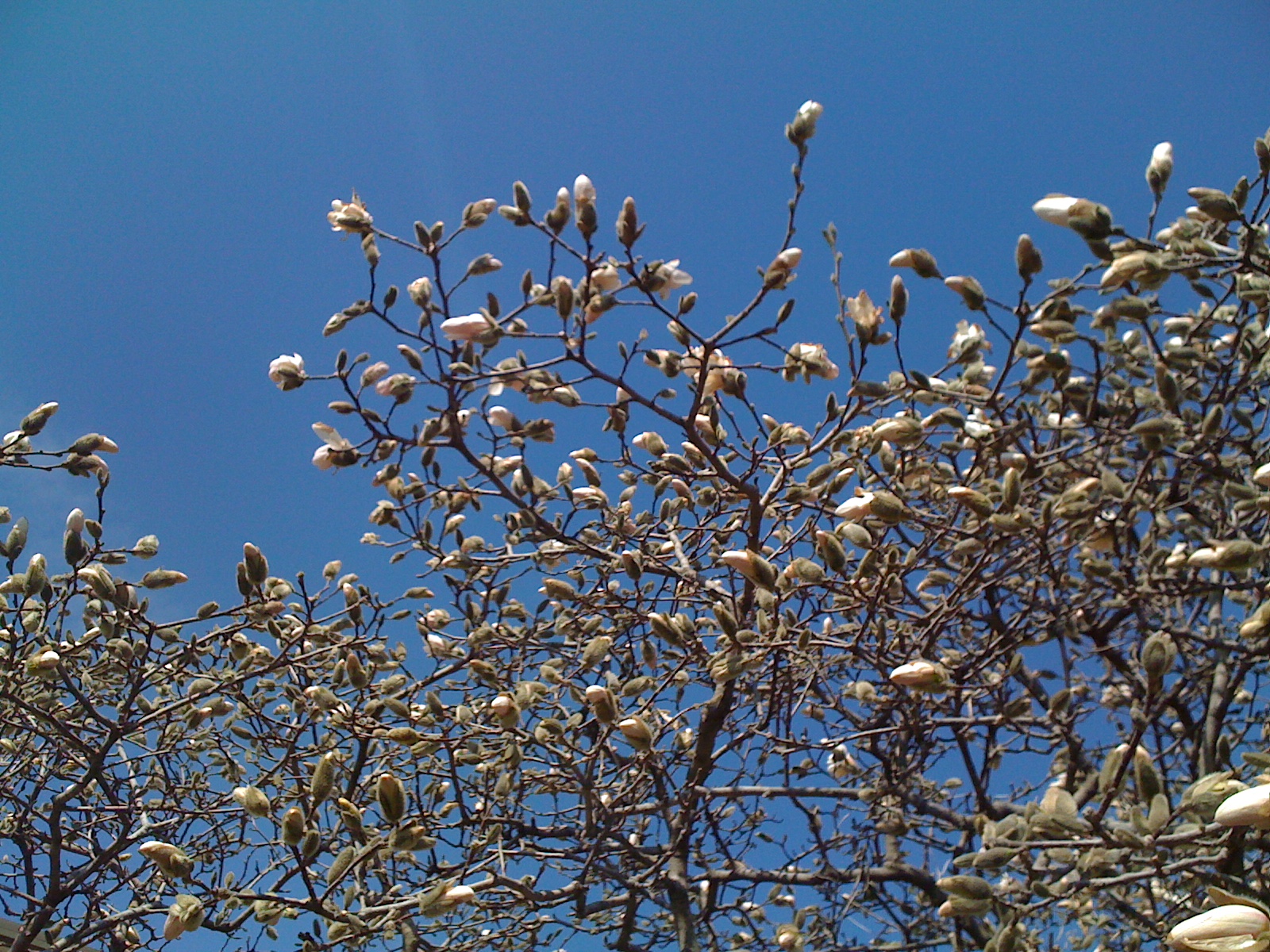
 Up the block was a Magnolia tree, the big pink flowers popping out of their calyxes, which lay all over the sidewalk like the empty hulls of giant pistachios, like the open mouths of birds. The shell-pink petals were still wrapped in large, conical buds, twice as long as their discarded calyxes. Yes, the heat is cooking all these flowers to an early emergence.

THE CHICKS ARE
FEATHERING OUT NICELY.

At home, crowds of Daffodils nod their heads in the breeze. Crocuses are open, too, the rich color of the yolks of my hens' eggs. Irises stand guard around the house, each leaf enfolded to make a fan growing taller every day, to form a spiky, dark green border. Lighter green day lilies emerge in a circle in the back yard like little symmetrical fountains of greenery. These won't bloom for a few months, but their vegetative parts are almost like green corsages pinned to the earth. Leaves of ghost lilies grow inches a day, and will fade even more quickly. Next to the birdbath we find red sprouts pushing out from amongst the dry, grey stalks of peonies. Everywhere we turn is a flower, or the promise of one. I find more Irises sprouting near my path to the door where I had forgotten I planted them. I will need to be extra careful when I mow in a week or two. Yes, the grass is greening up and growing fast.


The chicks are feathering out nicely, and I have been taking them outside to the little chick tractor during the day when it's sunny. It is a movable, bottomless coop so they can have access to the grass and all its varied treats. It's called a “tractor” because if you leave it in the same place for a while, a week or maybe a few days, the chickens will scratch so much that they can actually plow up your garden for you. I move it a little each day, so they can fertilize the yard evenly, but I don't let them plow up the lawn. When they get big, they will have the run of the whole yard. The grown up chickens come over to investigate and the chicks get flustered, running in a feathery flurry to get away from giant, curious beaks from above. Bit by bit they will get used to each other. Ursula noses the chicks' coop, but if you want to know the truth, she is most interested in their food. My dog could easily tear through the chicken wire in my little chick tractor, but I convince her that it's much more fun to chase a tennis ball. “Where's your ball?” I ask, and she tilts her head for a moment, and then turns toward the driveway, where we last had our game. She runs this way and that, searching, and in a few moments she returns with a faded tennis ball in her mouth. The game distracts her from the chicks and disaster is temporarily averted. She retrieves her ball again and again, and with each throw I move the game away from chicken territory. The chicks return to their inspection of their new grassy pen, and each in our own way, we enjoy the afternoon.
 
URSA NOSES THE CHICKENS' COOP
WELCOME BEAUTY; CULTIVATE PEACE; BLESSED BE.

PROMISE OF SPRING


A CLUSTER OF EMPTY VASES
READY TO FILL
SPRING HAS COME TO BIRDLAND IN THE SOFT GREENING OF THE WINTER-BROWN GRASS. Bulbs are pushing up in various fashion, the flat, green tongues of ghost lilies emerge stacked like pages from the damp earth; Daffodils thrust up in a green bouquet, like a gift from a friend; red edged tulips curl to make a cluster of empty vases, ready to fill; spikes of crocuses appear, like birthday candles, with a large, yellow flame. The Daffodils are already trumpeting their message: Hear Ye, Hear Ye! Spring Comes Early This Year.

 The wind blows fiercely, and in the yard, lawn furniture is overturned and twigs, branches, and even limbs snap off of trees and tumble to the ground. It seems like every day we right the chairs and carry broken branches to the mulch pile, but the spring yard is always in disarray. Ursula finds plenty of sticks to coax us into a game. Our dog loves to fetch. The big bushes in the front yard—some kind of dusky pink kin to the rose—has put out flower buds. They are like pink capers, wrapped tight against the wind. But the surest sign of spring in Birdland is peeping next to the wood stove. That's where the brooder is. Okay, you knew I was going to go back to that farm store and get those chicks, didn't you? We have a dozen. Six Buff Orpingtons, and three each of Rhode Island Reds and Barred Rock. They are straight run, which means that half will be pullets and half cockerels, the natural ratio. At the time, a dozen seemed like plenty, but suddenly only 6 hens next year seems like such a small number, especially accounting for predation. Maybe I'd better go back before the sale ends.
HEAR YE, HEAR YE!
SPRING COMES EARLY
THIS YEAR!


For now the chicks are in the brooder, under lights, but I hope soon the wind will die down, so I can set up a temporary pen in the grass. They'll be less bored outside, where they can scratch in the ground and snap up grass and dandelion greens. They'll be healthier, too, and easier to keep clean. Chicks only get “pasty butt” when they are in an artificial brooder. In the yard, grazing on a more varied and natural diet, they are in a better balance. Once they feather out and lose their soft down, they won't even need a light. Won't they be surprised to discover that the world is wider than the plastic crate they live in now?


Like Birthday Candles
with Yellow Flame
 “Spring is the mischief in me,” and the next thing I know, I'm online and looking up “Serama hatching eggs.” Seramas are the smallest breed of chicken. Sometimes called “the teacup chicken.” They are about the size of a large can of soup with a tail. A couple of my hens have been broody, lately. I find especially the little red hen sitting in the next box in the dark warming a clutch of eggs mostly stolen from her sisters. I could order a dozen Serama eggs, set up a nest in a crate in the basement and set her on top of the serama eggs. She would hatch them for me, and then raise the babies. They will follow her around the yard as she shows them how to scratch and peck in the wild jungle of grasses in the yard. When they get cold, she'll sit down so they can run to her and burrow into her warm feathers. They can live in the aviary with the finches and parakeets.

Hatch in Beauty: Bloom in Peace:
Blessed be.

The wind will die down; the sun will coax open more buds; new chicks will scratch and graze. Spring will come and leave us again to make way for summer.

Saturday, May 7, 2011

Mother's Day


My mother's gifts have informed who I am.


THIS TIME OF YEAR the days tumble over one another and if I'm not careful I forget to look for the yellow roses before it's too late. I almost forgot the asparagus too, but luckily got distracted on the way to feed the chickens and found myself by the grape arbor instead, which is just in front of the asparagus bed. I actually gasped aloud when I saw the shoots, a few of them already two feet tall. Another day and they would have been beyond steaming, woody and branching out to feathery ferns. I set the scoop of chicken feed on the grass and snapped off the shoots. They will grow back, and I will snap them off every few days. Dragon tail soup for the next six weeks until I have to stop harvesting and let the plants recover.


DUTCHMAN'S BREECHES AND SPRING BEAUTY
violets
Then my friend, Gayle, called. “Do you want some morel mushrooms?” she asked. “I found some in my yard, and I don't like mushrooms.” She cut them for me and I had a delicious stir fry, the greens of asparagus and broccoli made savory with the brown mushrooms and olive oil. Of course that reminded me that I need to get to the woods and see if it's too late for ramp—the wild leeks that grow so abundantly. I think it is too late. I'm afraid I have already missed most of the spring flowers—Dutchman's Breeches, Spring Beauty, Jack-in-the-Pulpit, Bluebell. Worse, I have missed the deadline for my Mother's Day musings. I should have been writing about this last week, but then the day was still just an abstraction, a vague, future event.

Grape Hyacinths

Today I am thinking of the yellow roses.

My task is to now gratefully recognize these gifts.
Inhale Beauty
Today I am thinking of the yellow roses that will come soon, and my mother, who used to have a lovely bed of climbing red roses by the front stoop. The roses were old-fashioned, more for rambling than cutting. As a child, I didn't appreciate them—thought their stems were too spindly, their thorns too sharp and close together. They were nothing like the florist variety, those tall elegant stems, like princesses standing straight up in a vase, demure face closed in a tight bud, or slightly open. These were messy and abundant, dropping petals and pollen, wild and uncontainable—sort of like my mother's children. Now in memory I see them in the sunshine (though they were on the north side of the house) two bushes out front, just full of crimson flowers. In my mind they will bloom all summer long. I'd like to drive past and see if they're still there, but afraid of how I'll feel if they're gone.

The roses and missed blooms have me thinking about my place as a daughter. I try to be a good one. Sometimes I think I achieve that; mostly I think I could do better. I could call more often, stop by for lunch once in awhile, offer my help with little projects. I think about those roses and the gifts my mother gave me. I'm told she taught me to read as a toddler, with flashcards attached to every conceivable noun in the house: table, chair, refrigerator, telephone, curtain, mother. After my children were born I once discovered an old reading workbook at a friend's house, and recognized instantly that it was the one my mother had used to teach me. Each letter had a mnemonic drawing to help a child remember the sound the letter made. H was for “Harry,” who was breathing heavily after running (“H-H-H-H”). He sat in chair made of a lower-case “h” to rest. Thumbing through that book brought home how many hours my mother must have spent reading to me and my brother and sisters.

My mother's gifts have informed who I am, not only as a daughter, but also as a sister, niece, friend, teacher, writer, and especially, mother. I know I could do better in those areas too, but here's the thing: What felt like instinct as I loved and cuddled and nurtured and disciplined and taught my own children was knowledge inherited, and inhaled at my mother's knee. My task now is to gratefully recognize those gifts and turn them back to my mother, and outward to the world.
Inhale Beauty; Exhale Peace; Blessed Be.

Mary Lucille Hays lives in Birdland near White Heath. She is interested in cycles and heritage and her own back yard. A week after Mother's Day she is still grateful for a loving mother. 

Thursday, November 25, 2010

Last Laundry

For the past few weeks in Birdland, hanging laundry has been a little chillier, a little riskier. It takes a little longer to dry, and sometimes isn't dry even as the sun sets. I have to gauge the probability of overnight rain, decide whether to leave the laundry up or take it down to finish in the drier. So far, I've opted for leaving it up, and always seem to luck out.

Hanging laundry in November is quite different from hanging laundry in August. First, let me explain. I love doing laundry. It's one of my many quirks. I don't understand people who think it's a chore. It's easy and satisfying. I don't have to think, just keep in the rhythm of hanging and folding, so my mind is free to wander. It takes some time, but the job has natural built-in breaks to it. The rhythm of the task encourages a quiet meditation, and I find satisfaction in folding the familiar clothes, now clean and soft, and ready to wear another day. Creating order from a pile of dirty clothes suits me.

Hanging the laundry takes me outside to enjoy the nice day—the breeze and the sun. But in November it begins to get tricky. I wea
r a heavy sweater, but I can’t keep my fingers warm. This makes it both more difficult to hurry, and more important to finish quickly. Laundry in November holds a little tinge of sadness. Winter seems to be late this year, yet we know it is coming. The gray skies hold snow, and the evenings come early. In the summer I can wash three cycles of clothes and have them dry and folded before supper. In November, I have to rush to finish even one load. As I struggle to hurry with the wet clothes, the late autumn air cools them. My damp fingers pull in the chill, and soon they are numb and aching, both at the same time. Now my fingers are clumsy, and my mind is no longer free to wander. Now I am wondering if this is the last laundry I will hang on the line. Will winter stop teasing us and settle in seriously now? Will the blizzards come, the temperature drop? Will my laundry freeze on the line into stiff cardboard cut-outs of shirts and pants? Will I be dispatched to the drier until Spring?

This week my laundry luck ran out. I left a batch of still damp clothes on the line one evening, and it rained for two days. Today the sun has returned, but some of the clothes are streaked with mud, blown across the yard from the field, I suppose. I’ll have to take it down to rewash. I wander around the yard, checking on things I should have taken care of before the frost. A basket of weeds sits in the middle of my half-weeded path; the rain barrel is full of ice, the sillcock frozen shut, so I can’t even open it in case of a thaw. I’ll need to weatherize the aviary outlets and plug in the lights and winter water dishes. All this would have been easier to do before the freeze hit, but every year I get lulled in to thinking Autumn will last forever, or at least one more day.

Now that Winter has come, I’ll turn my attention inward. I’ll work on interior, warm projects—cleaning out closets and painting them, knitting, writing, fixing the thermostat. I’ll take brisk walks with the dog, collecting stones for my spiral herb garden, but I’ll just leave these in a pile until Spring. I’ll make plans, bake bread, sing songs. I’ll clean the basement. I’ll plant seeds for Spring.

Walk in Beauty; Work in Peace: Blessed Be.

Mary Lucille Hays lives in Birdland near White Heath. She is interested in cycles, common things, and her own back yard.